

What is an apostille? It is a single certificate, issued by the government of the country where a public document was created, that confirms the signature, the title and the seal on that document so another country accepts it without further legalization. If your paper is going to Mexico, an apostille is usually the step that makes it usable there.
Send us the procedure you are planning and the state that issued your paper. We tell you what Mexico’s office usually expects and what to prepare first.
What is an apostille and what does it certify?
An apostille certifies three things: the signature on a public document is genuine, the person signed in the capacity stated, and the seal or stamp on it is real. It does not certify that the content of the document is true. The text of the Convention says the certificate is issued by the competent authority of the State where the document originates.
The Texas Secretary of State puts it plainly in its own guide: the apostille attests to the validity of the Texas public official, not to the contents of the underlying document. If you wonder what is an apostille worth to the receiving office, the answer is trust: the office relies on the certificate instead of calling the US agency. A birth certificate with an apostille is therefore a birth certificate whose official signature has been checked, nothing more and nothing less.
The certificate itself follows a model set by the Convention. It is placed on the document or on an attached page, and its title appears in French, “Apostille (Convention de La Haye du 5 octobre 1961)”, alongside the official language of the issuing authority. That is why an apostille from one state looks different from another’s but always carries the same numbered fields.
Where the apostille comes from: the 1961 Hague Convention
To understand what is an apostille, start with the treaty signed at The Hague on October 5, 1961, which entered into force on January 24, 1965. It replaced a chain of stamps from several offices with a single certificate, so a document can travel between member countries with one extra page.
The Convention covers public documents: court documents, administrative documents, notarial acts and official certificates placed on privately signed papers. It leaves out documents executed by diplomatic or consular agents and administrative documents dealing directly with commercial or customs operations. The HCCH Apostille Section adds that the Hague Conference itself cannot issue or verify apostilles; only the designated authorities of each member country can.
Where it works is part of what is an apostille: the certificate is valid for use in another member country. It does not work for documents that stay in the country where they were issued, and it does not replace a translation when the receiving office asks for one.
What is an apostille used for in real procedures?
An apostille is used whenever a foreign office asks you to prove that a US document is official: a marriage, a birth registration, a power of attorney, a school record, a business paper. The receiving office checks the apostille instead of contacting the US office that issued the document. Knowing what is an apostille used for in your case tells you which version of the document to order.
For families with ties to Mexico, three situations come up most often. A US birth certificate has to be used for a wedding in Mexico; a US-born child or parent needs papers for Mexican dual citizenship; or a signed power of attorney from the United States has to be accepted by a Mexican notary or registry.
The direction matters. A Mexican document that will be used in the United States is apostilled in Mexico, as we explain in our guide on how to apostille Mexican documents from the United States. A US document that will be used in Mexico is apostilled in the United States, which is the subject of this guide.
Who issues an apostille in the United States
The first practical question after what is an apostille is who issues it. In the United States, the apostille is issued by the Secretary of State of the state that issued or notarized the document, or by the federal government when the paper is federal. The HCCH list of US competent authorities describes this split, with a few local exceptions such as Georgia, where Superior Court Clerks handle it, and New Jersey, where the Division of Revenue does.

| Document | Office that apostilles it | Where to start |
|---|---|---|
| State birth, marriage or death certificate | Secretary of State of the issuing state | The state’s official apostille page |
| Document signed before a notary | Secretary of State of the state where the notary is commissioned | The notary’s commission state, not where you live now |
| FBI report or other federal agency paper | US Department of State, Office of Authentications | The Department’s authentication request page |
| Federal court document | Clerk of that federal court | The court’s clerk office |
| Consular report of birth abroad | Department of State, Vital Records Section | The Department’s vital records page |
The Department of State describes its role on its page about requesting authentication services: an apostille is for documents used in countries that belong to the Convention, and an authentication certificate is for countries that do not.
The California Secretary of State explains that a birth or death certificate issued with a local health officer’s signature may first need a county clerk certification or a new certified copy from the county recorder. Ask the state office before you mail anything.
How to get an apostille: step by step
To get an apostille, you need an original or certified document, the right issuing office, a completed request and the payment that office accepts. The order never changes, even though each state publishes its own form.
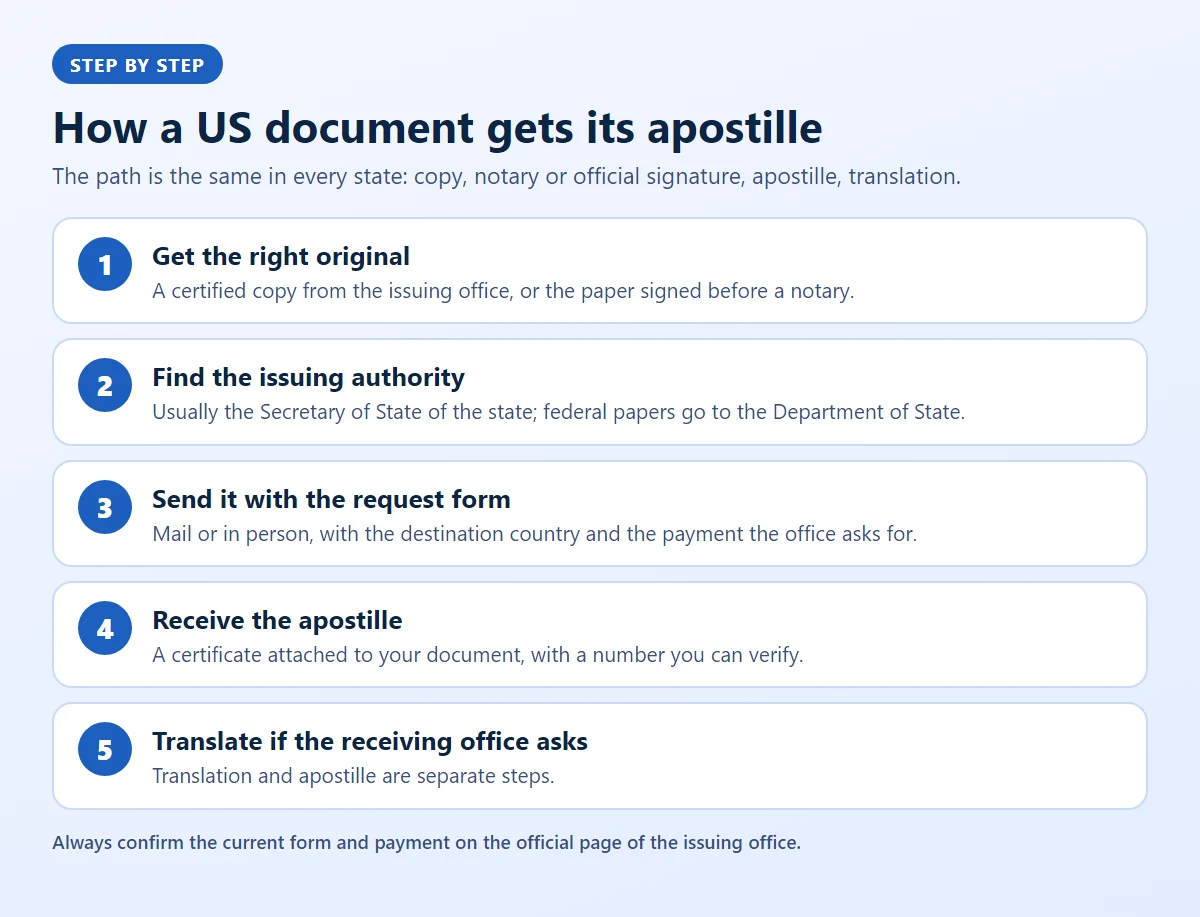
- Get the right original. Order a new certified copy of a vital record from the state or county; a photocopy cannot be apostilled. For a private paper, sign it before a notary.
- Find the issuing office. Use the state’s official apostille page and confirm that it covers your document type.
- Fill in the request. Each office asks for the country where the document will be used. California publishes cover sheets in English and Spanish.
- Send it in. By mail or in person, with the payment method the office lists. California states that mail requests are handled in the order received and cannot be expedited.
- Receive and verify it. Many states let the receiving office verify the apostille online; California runs a verification portal for apostilles issued in the last five years.
Notarization is its own step, and a notarized paper shows what is an apostille doing at the state level: it certifies the notary’s signature. The California Secretary of State does not provide notarial services, so a paper that needs a notary has to be notarized before it is submitted. If the notarization is in English, the office can issue the apostille even when the rest of the document is in another language.
We explain what is an apostille for your case, which version of your document the Mexican office will accept, check the order of steps and coordinate the Mexican records that go with it.
What is an apostille not? Common mix-ups
An apostille is not a translation, not a notarization and not a guarantee that the receiving office will approve your procedure. It is only the proof that the American official who signed your document really is who the paper says. Clearing up what is an apostille not saves most of the rework.
- Translation: it is a separate step, done by the translator the Mexican office accepts. Our guide on how to translate a birth certificate covers it.
- Notarization: a notary signs first, and the state then apostilles the notary’s signature.
- Legalization: this older, multi-office route applies to countries outside the Convention, where the Department of State issues an authentication certificate.
- Approval of content: the apostille says nothing about whether a statement in the document is correct.
The e-Apostille is a digital version, and the HCCH notes that it cannot be refused simply because it is electronic. Whether a given Mexican office takes the electronic version is a question for that office, so keep a paper original at hand.
Apostille or authentication certificate: which one do you need?
Answering what is an apostille versus an authentication certificate comes down to the country list. You need an apostille when the destination country is one of the 130 contracting parties, and an authentication certificate when it is not. The HCCH status table is the list to check, and Mexico appears on it.
| Destination | Certificate | Why |
|---|---|---|
| Mexico, Canada, Spain, France, Japan, India, Brazil | Apostille | All appear on the HCCH table of contracting parties |
| A country that does not appear on the table | Authentication certificate | The Department of State issues it for federal papers; the state office handles state papers with further steps |
| A country that joined recently | Check the entry-into-force date | The treaty applies from the date HCCH lists, not from the date of signature |
The table also shows that some countries are very recent. Thailand deposited its accession on June 30, 2026 and the HCCH lists entry into force on February 28, 2027. A paper bound for a new member should be checked against that date before you apply.
Whatever the answer to what is an apostille in your case, we look at the whole file with you so the apostille does not arrive in the wrong version.
Mistakes that delay an apostille
Once you know what is an apostille and what is not, you see that most delays come from the document, not from the office. Sending the wrong version, mixing up states or skipping a county step are the three that appear most often.
- Use a recently issued certified copy, not an old photocopy
- Match the state to the issuer of the document, or to the notary’s commission state
- Write the destination country on the request form
- Keep the name spelled the same way on every paper in the procedure
- Ask the receiving office, before you send, whether it wants a translation and from whom
California adds a useful practical point: its Sacramento office was processing mail requests received on November 10, 2026 on the page’s latest update of November 19, so a mailed request can take a while. Same-day service exists at the counter in Sacramento and Los Angeles and at periodic pop-up events with counties. If time matters, an in-person visit is the faster route in that state.
Related guides: the affidavit of single status for marrying in Mexico.
FAQ: what is an apostille
What is an apostille in simple words?
It is a certificate stapled or attached to a public document that tells another country the signature and seal on it are real. The receiving office then accepts the document without asking the original office to confirm it. That is what is an apostille in one sentence: proof of authenticity.
Does an apostille expire?
The Convention does not set an expiry date. Some receiving offices, however, ask for a certified copy issued within a recent period, so check the age rule of the office that will receive it.
What is an apostille compared with a notarization?
A notarization confirms that someone signed in front of a notary. An apostille then confirms that the notary’s own signature and commission are real, which is what a foreign office needs to see.
What is an apostille worth without a translation?
It still proves the document is official, but the receiving office may not be able to read it. Ask that office whether it wants a translation and who may do it.
Can I get an apostille for a photocopy?
No. The California Secretary of State states that photocopies are not accepted: the document must carry the signature of a California public official or be an original notarized or certified paper. Order a fresh certified copy instead.
Is the apostille valid in Mexico?
Yes. Mexico is a contracting party, with entry into force on August 14, 1995, so a US apostille is the recognized certificate for US public documents used there, which is what is an apostille worth in practice: acceptance by the Mexican office. The Mexican office may still ask for an official translation.
How MLDS helps when what is an apostille becomes a real procedure
Understanding what is an apostille is the easy part; preparing the file is where we help. MLDS does not issue US apostilles; the Secretary of State of each state does. What we do is guide you on how to prepare a US document for use in Mexico and handle the Mexican records that sit next to it, such as certified birth, marriage or death certificates and corrections to them.
If you are unsure what is an apostille going to change in your case, write to us from the contact page with the procedure, the state and the documents you already hold. We answer with the order of steps that fits your situation.
Keep going with our guides on Hague Convention countries and apostille for a birth certificate.