 Mexico Legal & Document Services
How to Translate a Mexican Birth Certificate to English
Many procedures in the United States — immigration, school, work — require a Mexican birth certificate along with a certified English translation.
To translate birth certificate documents correctly avoids delays with USCIS and other agencies.
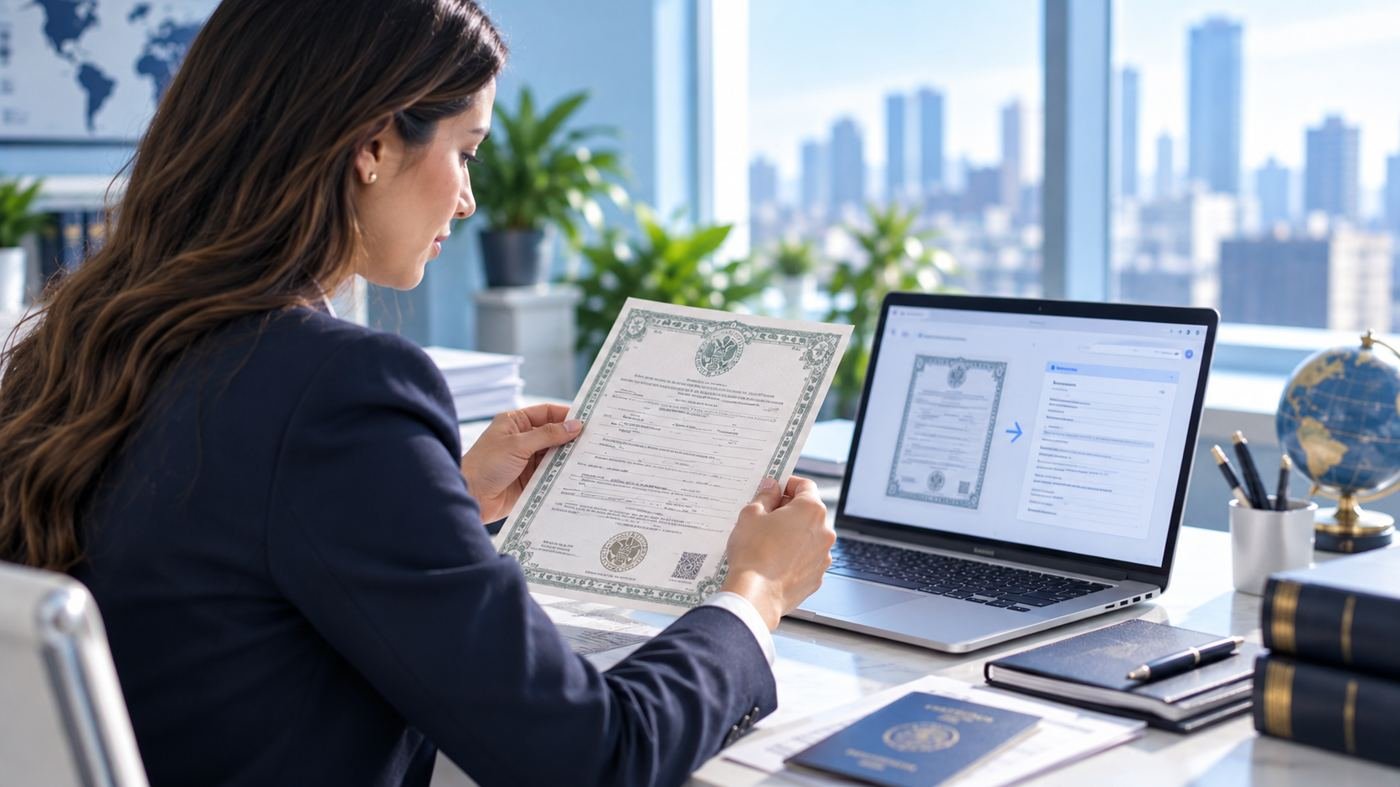
Translate Birth Certificate: certified translation, not just any translation
Most U.S. institutions require a certified translation — one accompanied by a statement from the translator regarding its accuracy. An informal translation, even a well-done one, usually isn’t enough.
Order matters: fix the certificate first
Translating a certificate that already has an error (in the name, the date, or the parents’ information) simply carries that error over into English. That’s why it’s best to review — and correct if needed — the certificate in Mexico before sending it for translation.
What to check before translating
- That the names match exactly with other identity documents.
- That the date and place of birth are correct.
- That it’s a recent certified copy, not an old or damaged one.
The federal rule that requires a full translation
This rule is why you must translate birth certificate documents in full, not just a summary.
The translation requirement isn’t a preference left to each USCIS officer — it’s a federal rule. The USCIS Policy Manual, Volume 1, Part E, Chapter 6 states that any foreign-language document submitted as evidence must be accompanied by a full English translation, along with a certification signed by the translator declaring that the translation is complete and accurate and that they are competent to translate from Spanish into English. The same manual explicitly clarifies that “a summary of a document prepared by a translator is unacceptable” — meaning it’s not enough to translate only the parts that seem relevant.
This same full-translation requirement is repeatedly required when a birth certificate is used as evidence in a family petition through Form I-130, one of the procedures where a translated Mexican birth certificate is most frequently requested.
Who can do the translation
Contrary to what many people assume, there is no official list of “government-certified” translators for this procedure in the United States. According to the American Translators Association (ATA), any individual or company can certify a translation for USCIS, as long as they sign the certification of accuracy and competency — the translator does not need to be accredited by ATA or any other organization. That said, ATA itself recommends using a professional translator (for example, one found through its directory) precisely because it reduces the risk of USCIS questioning the translation and requesting a correction.
For translations that must also be presented in court (not just to USCIS), it’s often recommended to use a translator certified by organizations that specialize in the legal field, such as the National Association of Judiciary Interpreters and Translators (NAJIT), whose public directory helps locate translators with specific experience in legal and judicial documents.
The most common mistake
This mistake is easy to avoid once you translate birth certificate documents the right way.
The mistake that most often triggers a Request for Evidence (RFE) isn’t the quality of the translation itself — it’s submitting only the translation without attaching a legible copy of the original Spanish-language birth certificate. USCIS requires both documents together — the original and the translation — so it can confirm the translation actually corresponds to the document submitted.
This obligation also has specific regulatory backing: the USCIS Policy Manual itself cites federal regulation 8 CFR 103.2(b)(3) as the legal basis for the full-translation requirement, meaning it is not a discretionary criterion left to each officer, but a rule that applies to any immigration procedure.
In practice, this means a certified translation of a Mexican birth certificate should mirror the original document line by line — including any stamps, seals, marginal notes, or corrections — rather than only the main biographical fields.
Do you need to correct your certificate before translating it?
Write on WhatsApp