

Mexican dual citizenship is open to many people born in the United States to a Mexican father or mother, and to people born in Mexico who were never registered there. This guide explains who qualifies, which documents the consulates ask for, how the appointment works and what you can do once you have your Mexican birth certificate, so the whole process starts in the right order.
What Mexican dual citizenship means
Mexican dual citizenship means that a person holds Mexican nationality and, at the same time, another one, such as U.S. citizenship. For someone born in the United States, the practical step is registering the birth at a Mexican consulate, which produces a Mexican birth certificate.
That registration does not change your U.S. citizenship. It records, in the Mexican Civil Registry, that you are the child of a Mexican parent, and it gives you a certificate you can later use to request other Mexican documents.
Many people search for it as “dual citizenship Mexico” or “how to get Mexican citizenship”. The consulates call the procedure “doble nacionalidad”, and their requirement pages use that term.
Who can apply for Mexican dual citizenship
People born outside Mexico to a Mexican father or mother can apply for Mexican dual citizenship, and so can people born in Mexico who live abroad and were never registered there, as the Consulate General of Mexico in San Antonio describes.
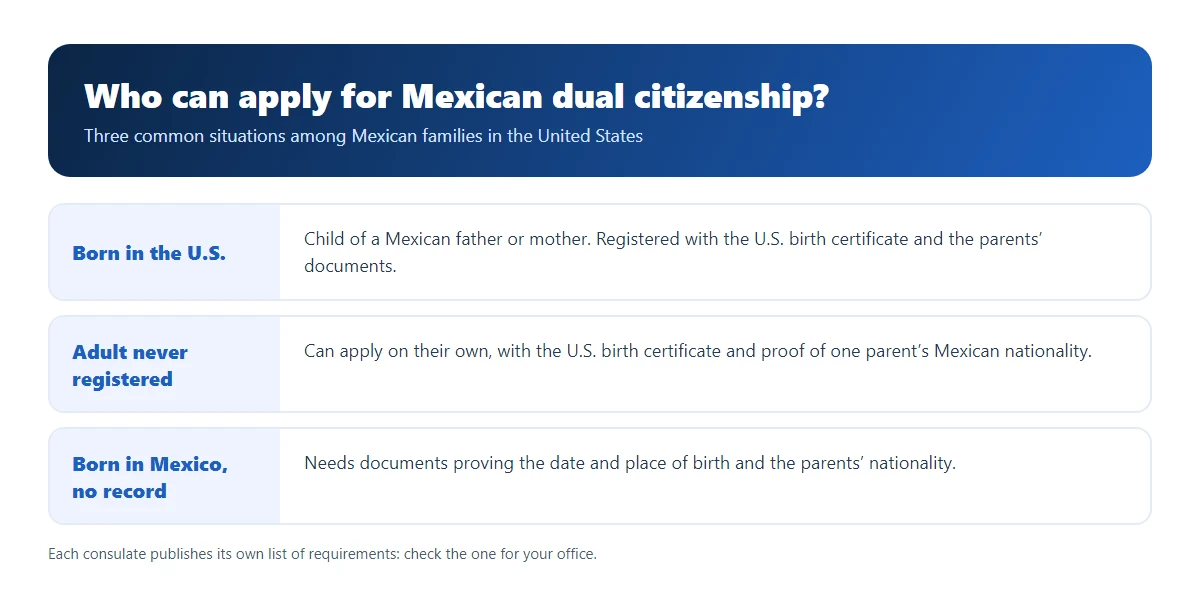
Three situations are common among Mexican families in the United States:
- A child born in the United States: registered with the U.S. birth certificate and the documents of the Mexican parents.
- An adult who was never registered: can apply on their own, with their U.S. birth certificate and proof of one parent’s Mexican nationality.
- A person born in Mexico with no registration: needs documents that prove the date and place of birth and the parents’ nationality.
Each consulate publishes its own list of requirements, so read the one for your consulate before you gather papers. For a minor, consulates also ask for the parents’ IDs and, in general, for both parents to be present; ask your office how it handles a case where one parent cannot attend.
Plan the family calendar too. Getting the parents’ Mexican birth certificates can take longer than the appointment itself, especially if one was issued in another Mexican state, so start there and book the appointment once you have everything at hand.
Documents for Mexican dual citizenship
The documents change with the applicant’s age and the consulate, but they almost always include the U.S. birth certificate, an ID and the birth certificates of the Mexican parents. These are the groups of documents the consulates mention:
- U.S. birth certificate: original, in good condition and not an abstract, with the parents’ names written as they appear on their Mexican documents.
- ID of the person being registered: passport, driver’s license or another valid official ID. For minors, some consulates accept a school ID with a photo.
- Birth certificates of the Mexican parents: originals; if a parent became a naturalized Mexican, the naturalization letter.
- Parents’ IDs: official, valid, with photo and signature.
- Parents’ marriage certificate: the Consulate of Mexico in Los Angeles asks for it, dated six months before the birth, when the person registers on their own.
If the parents were not married, or married after the birth, that same consulate says the father must attend the second appointment or grant a special notarized power of attorney so his name appears on the certificate.
The Mexican birth certificate behind Mexican dual citizenship
The key document in this process is the birth certificate. If your certificate or your parents’ certificates have a mistake in a name, a date or a surname, the consulate may return the file, and anything that does not match between documents delays the appointment.
That is why it pays to review every certificate before booking. If you need a recent certified copy of a parent’s Mexican certificate, our certified Mexican civil records service can request it, and if you find a misspelled detail, the route is a Mexican birth certificate correction.
Once the Mexican certificate is issued, review it as soon as you receive it. A typo found on the same day is fixed far more easily than one found years later, when it has already been copied into a passport or a CURP.
How to apply for Mexican dual citizenship step by step
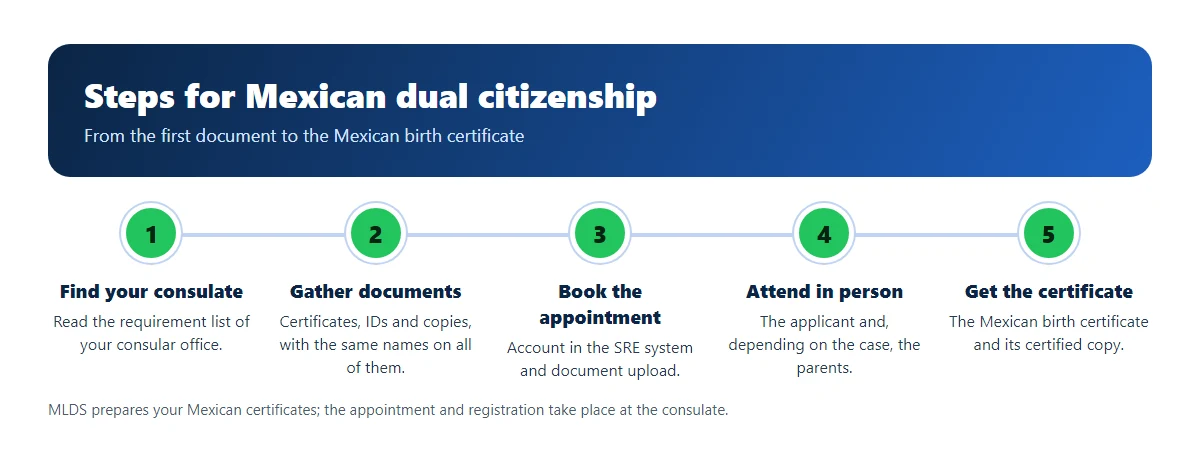
To apply, you gather the documents, book an appointment at the consulate and attend to register the birth. The practical order is this:
- Step 1, find your consulate: choose the consular office for your area and read its list of requirements, since each one may differ.
- Step 2, gather the documents: separate originals and copies, and compare the names on every paper letter by letter.
- Step 3, book the appointment: the San Antonio consulate explains that you create an account in the SRE appointment system, choose the office, upload the documents and, if there are no observations, an appointment is assigned.
- Step 4, attend the appointment: the San Antonio consulate says that everyone taking part in the procedure appears in person at the consular office.
- Step 5, receive the certificate: once the birth is registered, the Mexican birth certificate and its certified copy are issued.
At the Los Angeles consulate, for example, the process takes two visits: the first to review documents and the second to register the birth. Ask whether your consulate works the same way, and always bring originals plus one copy of each document so you do not need an extra visit for a missing page. Keep a folder with the receipts and the appointment confirmation as well, in case the office asks for them.
What changes after Mexican dual citizenship
After the registration you have a Mexican birth certificate and can request the documents that rely on it, such as the CURP and the Mexican passport. For many families, that is the goal: handling Mexican paperwork without depending on the U.S. certificate.
For the passport, our guide on how to apply for a Mexican passport from the United States explains the consular process. If your passport or other papers show a name that does not match the certificate, sort it out before filing new requests.
One travel rule matters: the U.S. Department of State notes on its dual nationality page that U.S. citizens with another nationality must enter and leave the United States on their U.S. passport. With both nationalities, carry both passports and use each one in its own country.
Common mistakes with Mexican dual citizenship
The most frequent mistakes are arriving with details that do not match, bringing a damaged U.S. certificate and forgetting the document that proves the link with the Mexican parent.
- Different names across documents: one accent or one surname spelled differently between the certificate and the ID stops the registration.
- Abstract or damaged certificate: some consulates ask for the original, complete and in good condition.
- Missing the appointment or coming without the parents: when the consulate requires them, the appointment is rescheduled.
- Assuming the requirements: what one consulate asks for does not always match another.
- Not keeping the new certificate safe: it is the document you will use later for the CURP and the passport.
Related guides: how to grant a power of attorney for use in Mexico and the three service modalities.
Mexican dual citizenship FAQ
How much does Mexican dual citizenship cost?
The San Antonio consulate says on its page that the registration is free and that the first certified copy of the certificate is free too; additional copies have a fee. Confirm it with your consulate before the appointment.
Can I apply without my parents?
An adult can register on their own at some consulates, with their U.S. birth certificate, their ID and proof of one parent’s Mexican nationality. Each consulate sets its own conditions, so read them first.
Do I have to travel to Mexico for Mexican dual citizenship?
For someone born in the United States, the registration takes place at the Mexican consulate for their area. If a parent’s certificate needs a correction in Mexico, that work can be coordinated remotely.
Will I lose my U.S. citizenship with Mexican dual citizenship?
Registering at the consulate does not change your U.S. citizenship, which follows U.S. rules. For travel and procedures in the United States, follow the Department of State guidance quoted above.
How MLDS helps with Mexican dual citizenship
MLDS organizes the documents behind your application: we locate and request certified copies of Mexican records, correct errors in birth certificates before the Civil Registry and coordinate procedures in Mexico for people living in the United States. You attend the appointment and registration at the consulate; we get the papers ready.
If you want us to review your case, write to us from our contact page and tell us which certificates you already have. The Spanish version of this guide is doble nacionalidad mexicana desde EE. UU.
Sigue leyendo: How to apply for a Mexican passport from the United States · Mexican birth certificate replacement from the U.S.