

Hague Convention countries are the 130 states that, as of June 30, 2026, belong to the 1961 Apostille Convention, so a public document apostilled in one of them is accepted in the others without further legalization. Mexico and the United States are both on the list, which makes the US apostille the right certificate for papers that travel between them.
Tell us where the paper is going and which procedure it supports. If it is Mexico, we guide you on the version the office expects and the Mexican records that go with it.
What the Hague Convention countries list actually tells you
The list of Hague Convention countries tells you which governments have agreed to accept a single certificate, the apostille, instead of a chain of consular stamps. It does not tell you what a given office will ask for in addition, such as a translation or a recent issue date.
The Convention was concluded on October 5, 1961 and entered into force on January 24, 1965. Its text says that the apostille is the only formality a member state may require to certify a signature, the capacity of the signer and the identity of a seal, when the document originates in another member state. The full wording is on the HCCH page of the Convention.
The full list of Hague Convention countries (HCCH, June 30, 2026)
The table below reproduces every contracting party in the HCCH status table, with the year the Convention entered into force for it. Names are shortened where the HCCH uses a long formal form. For an exact date, open the HCCH table itself.
| Letters | Country (year in force) |
|---|---|
| A | Albania (2004), Algeria (2026), Andorra (1996), Antigua and Barbuda (1981), Argentina (1988), Armenia (1994), Australia (1995), Austria (1968), Azerbaijan (2005) |
| B | Bahamas (1973), Bahrain (2013), Bangladesh (2025), Barbados (1966), Belarus (1992), Belgium (1976), Belize (1993), Bolivia (2018), Bosnia and Herzegovina (1992), Botswana (1966), Brazil (2016), Brunei Darussalam (1987), Bulgaria (2001), Burundi (2015) |
| C | Cabo Verde (2010), Canada (2024), Chile (2016), China (2023), Colombia (2001), Cook Islands (2005), Costa Rica (2011), Croatia (1991), Cyprus (1973), Czechia (1999) |
| D–F | Denmark (2006), Dominica (1978), Dominican Republic (2009), Ecuador (2005), El Salvador (1996), Estonia (2001), Eswatini (1968), Fiji (1970), Finland (1985), France (1965) |
| G–I | Georgia (2007), Germany (1966), Greece (1985), Grenada (2002), Guatemala (2017), Guyana (2019), Honduras (2004), Hungary (1973), Iceland (2004), India (2005), Indonesia (2022), Ireland (1999), Israel (1978), Italy (1978) |
| J–L | Jamaica (2021), Japan (1970), Kazakhstan (2001), Kosovo (2016), Kyrgyzstan (2011), Latvia (1996), Lesotho (1966), Liberia (1996), Liechtenstein (1972), Lithuania (1997), Luxembourg (1979) |
| M | Malawi (1967), Malta (1968), Marshall Islands (1992), Mauritius (1968), Mexico (1995), Monaco (2002), Mongolia (2009), Montenegro (2006), Morocco (2016) |
| N–P | Namibia (2001), Netherlands (1965), New Zealand (2001), Nicaragua (2013), Niue (1999), North Macedonia (1991), Norway (1983), Oman (2012), Pakistan (2023), Palau (2020), Panama (1991), Paraguay (2014), Peru (2010), Philippines (2019), Poland (2005), Portugal (1969) |
| R–S | Republic of Korea (2007), Republic of Moldova (2007), Romania (2001), Russian Federation (1992), Rwanda (2024), Saint Kitts and Nevis (1994), Saint Lucia (2002), Saint Vincent and the Grenadines (1979), Samoa (1999), San Marino (1995), Sao Tome and Principe (2008), Saudi Arabia (2022), Senegal (2023), Serbia (1992), Seychelles (1979), Singapore (2021), Slovakia (2002), Slovenia (1991), South Africa (1995), Spain (1978), Suriname (1975), Sweden (1999), Switzerland (1973) |
| T–Z | Tajikistan (2015), Thailand (2027), Tonga (1970), Trinidad and Tobago (2000), Tunisia (2018), Türkiye (1985), Ukraine (2003), United Kingdom (1965), United States of America (1981), Uruguay (2012), Uzbekistan (2012), Vanuatu (1980), Venezuela (1999), Viet Nam (2026) |
Thailand deposited its accession on June 30, 2026 and the HCCH lists entry into force on February 28, 2027, so the Convention does not yet apply to it. Among Hague Convention countries, Viet Nam (September 11, 2026) and Algeria (July 9, 2026) have both passed their dates and are now in force.

How to read an entry: accession, entry into force and objections
Each entry in the list of Hague Convention countries has more than one date, and the one that matters is entry into force. A country can deposit its accession months before the treaty starts to apply to it, as the Thailand entry shows.
There is a second layer. Under Article 12 of the Convention, a country that joins later is bound only toward states that do not object within six months of receiving notice, and objections go to the Dutch Ministry of Foreign Affairs. For a particular pair of Hague Convention countries, the HCCH status table is the place to check whether any objection exists.
- Entry into force: the date the Convention starts to apply to that country.
- Accession versus ratification: both make a country a member; the table shows which route each used.
- Objections: a member can object to a later joiner, and then the Convention does not apply between those two states.
- Territories: some countries extend the Convention to territories under Article 13, which the HCCH table notes.
We look at the procedure you have in mind and tell you which certificate the office expects. For Mexico, we also coordinate the Mexican records your file needs.
Which Hague Convention countries matter most for Mexican families
For families between the United States and Mexico, three entries matter: the United States, Mexico and the country where the paper was issued. A US document used in Mexico gets a US apostille; a Mexican document used in the United States gets a Mexican one.
That direction is why we wrote two guides. This one explains the Hague Convention countries behind the certificate, our guide on how to apostille Mexican documents from the United States covers the Mexican side, and our checklist on Mexican documents for immigration shows where the apostille appears in a typical file.
Other Hague Convention countries come up often in the same families: Spain, Canada, Brazil, Colombia, China and India all appear, with years in force from 1978 for Spain to 2024 for Canada. A paper going to any of them follows the same logic as one going to Mexico, with that country’s own receiving rules.
What if the country is not one of the Hague Convention countries?
If the destination does not appear on the table, the apostille does not apply and the document goes through authentication or legalization instead. The Department of State describes this on its page about requesting authentication services: apostille certificates are for countries in the 1961 treaty and authentication certificates are for countries that are not.
As of the June 30, 2026 table, examples that do not appear include Egypt, Nigeria and Ethiopia. If you are unsure, search the table for the destination before you pay for any certificate, and ask the foreign office which certificate it wants.
| Destination | Certificate | Who issues it for a state document |
|---|---|---|
| A country on the HCCH table | Apostille | The Secretary of State of the issuing state, with exceptions such as Georgia and New Jersey |
| A country not on the table | Authentication certificate | The Department of State, after the state step |
| A country whose accession is not yet in force | Ask first | The HCCH date decides when the apostille starts to work |
Step by step: how to use the list of Hague Convention countries
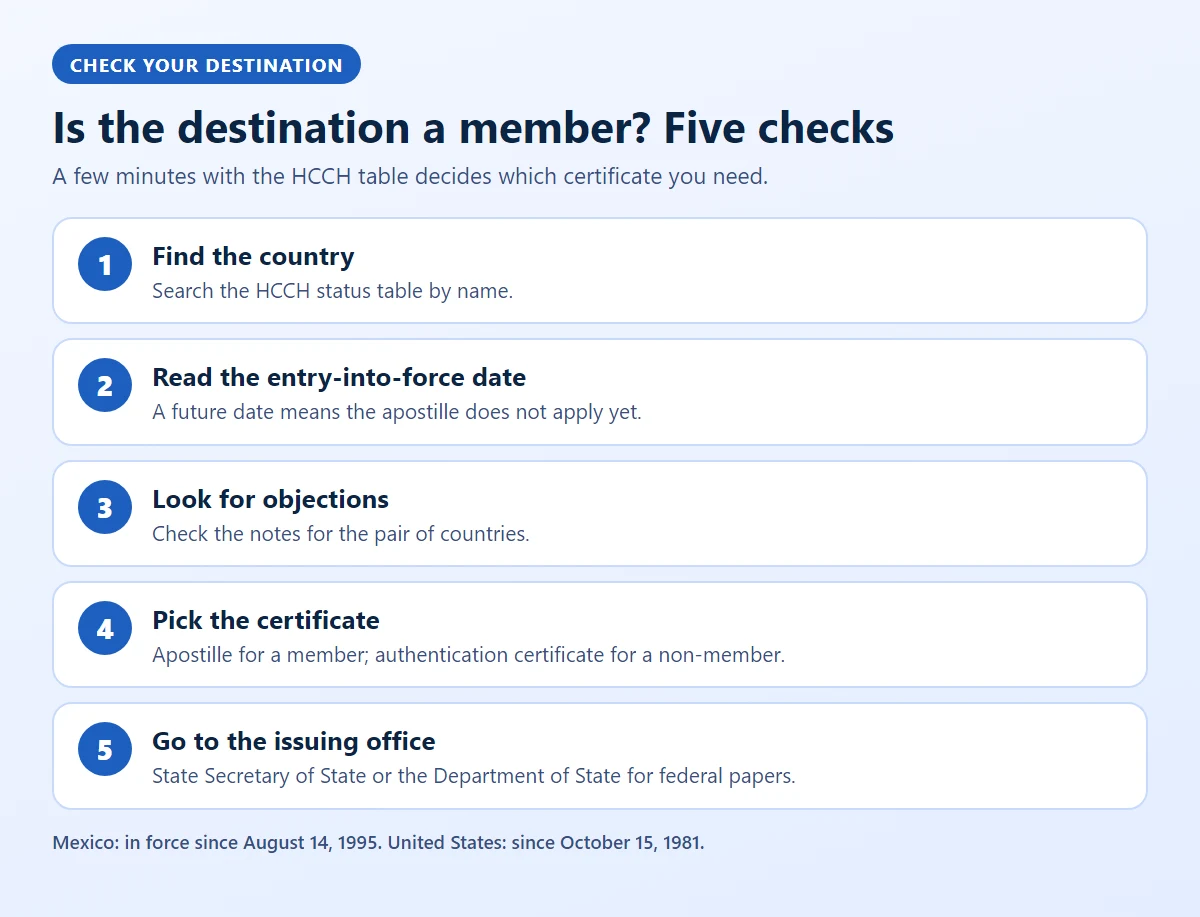
Using the list of Hague Convention countries takes five moves: find the destination, read the date, check for objections, pick the certificate and go to the issuing office. The whole check takes a few minutes and avoids paying a state for the wrong certificate.
- Find the destination. Open the HCCH status table and search for the country by name.
- Read the entry-into-force date. If it is in the future, the apostille does not yet apply.
- Check for objections. Look at the notes in the HCCH table for the pair of countries involved.
- Pick the certificate. Apostille for a member, authentication certificate for a non-member, and ask the foreign office for any extra rule.
- Go to the issuing office. For a state document, the Secretary of State; for a federal one, the Department of State.
The HCCH page for US competent authorities lists who issues US apostilles. The Office of Authentications handles federal agency documents, federal court clerks handle court papers and, in general, state Secretaries of State handle state documents.
Mistakes people make with Hague Convention countries
The usual mistakes come from assuming that membership solves everything. It solves the certificate, not the rest of the file.
- You checked the entry-into-force date, not just the country name
- You confirmed that the foreign office accepts the apostille for your type of document
- You asked whether a translation is needed, and who may prepare it
- You sent the document to the office that issued it, not to your local one
- You kept the apostille attached to the paper as the state returned it
One more point: documents executed by diplomatic or consular agents, and administrative documents dealing directly with commercial or customs operations, fall outside the Convention under Article 1. If your paper is one of those, the apostille will not apply, and the receiving office will tell you what it wants instead.
Tell us what the Mexican office asked for. We review the list, tell you what to prepare in the United States and coordinate the Mexican records.
Related guides: the California Secretary of State apostille process.
FAQ: Hague Convention countries
How many Hague Convention countries are there?
There are 130 contracting parties on the HCCH status table as of June 30, 2026. That count includes Thailand, whose accession enters into force on February 28, 2027.
Is Mexico one of the Hague Convention countries?
Yes. Mexico is a contracting party, with entry into force on August 14, 1995, so a US apostille is the recognized certificate for US public documents used there.
Is the United States one of the Hague Convention countries?
Yes. The Convention entered into force for the United States on October 15, 1981, and US states, federal agencies and federal courts act as competent authorities depending on the document.
Where can I check the list of Hague Convention countries for updates?
The HCCH status table is the official list. It shows the date of the last update, so note that date when you check.
Can MLDS apostille my document?
No. The apostille is issued by the competent authority of the country and state where the document originates. MLDS guides you on preparing your document for Mexico and handles the Mexican records connected to it.
How MLDS helps when your document is going to Mexico
Knowing which Hague Convention countries accept the apostille is a first step. The next is knowing what the Mexican office wants next to it. MLDS coordinates certified civil records in Mexico, corrections and the order in which your documents should be prepared.
Write to us from the contact page with the procedure, the state that issued your paper and the documents you hold, and we reply with the steps that fit your case.
Keep going with our guides on what an apostille is and US Department of State apostille.