

Going from an E2 visa to green card status is a question almost every Mexican investor asks, and the honest starting point is that the two are different things. The E-2 is a nonimmigrant visa tied to a business you run, while a green card is permanent residence obtained through a separate category. This guide explains how each one works, which general paths exist and how to plan an E-2 file with the long term in mind.
If you are still deciding whether the E-2 fits your case, start with our page on E2 visa requirements for Mexican citizens. Here we focus on the E2 visa to green card question and on what happens after the visa is in your hands.
Is there a direct E2 visa to green card route?
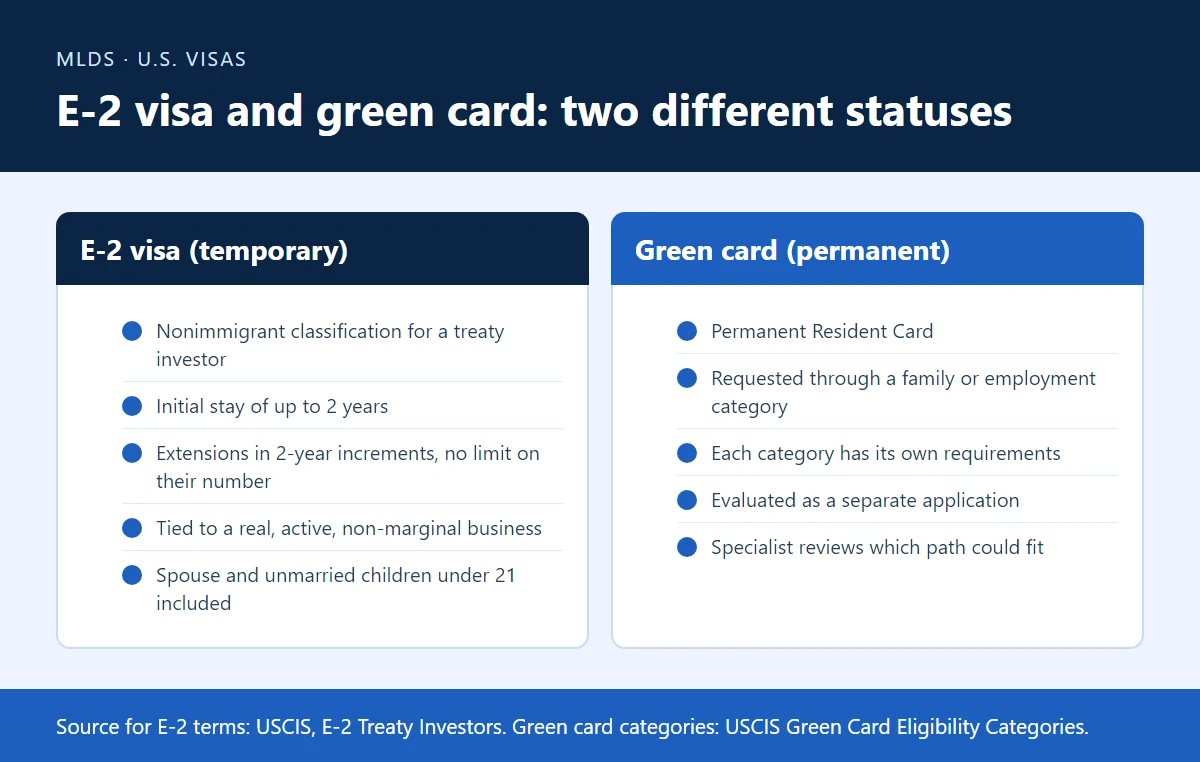
There is no automatic E2 visa to green card conversion. The E-2 is a temporary classification, and permanent residence has to be requested through one of the categories USCIS lists, such as family or employment. Each category has its own requirements.
USCIS describes the E-2 as a nonimmigrant classification that admits a national of a treaty country who invests a substantial amount of capital in a U.S. business. It also states that all E-2 nonimmigrants must maintain an intention to depart the United States when their status expires or is terminated. That wording is the reason the E-2 is not a residence program by itself.
A green card, officially called a Permanent Resident Card, allows a person to live and work permanently in the United States. USCIS notes that the steps to apply vary with each person’s situation, and that an applicant must be eligible under one of its listed categories. So the useful question is not whether the E-2 turns into a green card, but which category could fit your life later on.
- E-2 visa: temporary status, tied to the business you invested in and direct.
- Green card: permanent residence, requested through a family or employment category.
- Connection: both can exist in your history, but each one is evaluated on its own file.
What the E-2 gives you while the business operates
On the E2 visa to green card timeline, the first stage is the E-2 itself: it lets you live in the United States and direct your business with renewals available as long as the company keeps qualifying. USCIS allows stays in increments of up to two years and sets no limit on the number of extensions.
According to USCIS, qualified treaty investors and employees are allowed a maximum initial stay of two years. Requests for extension of stay in, or changes of status to, E-2 classification may be granted in increments of up to two years each, and there is no limit to the number of extensions an E-2 nonimmigrant may be granted. For many owners, that open-ended renewal structure is the main strength of the E2 visa to green card conversation: the business can be a long-term base.
The family is part of the E2 visa to green card picture from the start. Spouses and unmarried children under 21 may accompany or follow the treaty investor, and their nationality does not have to match yours. Spouses of E-2 workers in valid E-2 or E-2S status are considered employment authorized incident to status, according to USCIS.
An E-2 nonimmigrant who travels abroad and is found admissible by a CBP officer may generally receive an automatic two-year period of readmission on return. The visa follows the business: it keeps working as long as the enterprise stays real, active and non-marginal, and you keep directing it.
General paths from E-2 toward permanent residence
In an E2 visa to green card plan, some E-2 holders later qualify for permanent residence through family, employment or investment categories. Which one applies depends on facts that have nothing to do with the E-2 itself, and an attorney should review them case by case.
USCIS groups green cards into categories on its eligibility page. The groups relevant to an investor’s life are family relationships and employment-based categories. We describe them here in general terms; whether a given person qualifies depends on the facts of the case.
Through family
A green card can come through a relationship with a U.S. citizen or a lawful permanent resident, for example as the spouse or unmarried child under 21 of a U.S. citizen. These categories depend on the relationship, so the E-2 does not create or remove eligibility. If your family situation changes, the attorney can look at the options that apply.
Through employment
USCIS lists employment-based categories. One of them, the first preference EB-1, includes certain multinational managers or executives who have been employed outside the United States for at least one year in the three years before the petition, working for a qualifying U.S. petitioner that has been doing business for at least one year. Another is the EB-5 immigrant investor category.
Through the EB-5 investor program
Under EB-5, USCIS says investors and their spouses and unmarried children under 21 are eligible to apply for lawful permanent residence if they make the necessary investment in a commercial enterprise in the United States and plan to create or preserve 10 permanent full-time jobs for qualified U.S. workers. This is a separate investment program with its own rules, and it is not the same filing as the E-2.
In any E2 visa to green card discussion, the E-2 and these categories answer different questions. The E-2 asks whether your business qualifies for temporary status. The green card categories ask whether you meet the requirements of a permanent residence category. A path that works for one case may not suit another.
How to plan your E-2 file with the long term in mind
Planning an E2 visa to green card strategy starts with a clean, consistent E-2 file: a real business, documented funds and an accurate plan. A strong record helps any later step, because every USCIS or consular review reads the same history.
The business is the core of the record. USCIS requires a bona fide enterprise that is real, active and operating, and not marginal, which means it should have the capacity to generate more than a minimal living for the investor and family, now or within five years of the start of the E-2 status. The business plan we prepare with each client documents that capacity.
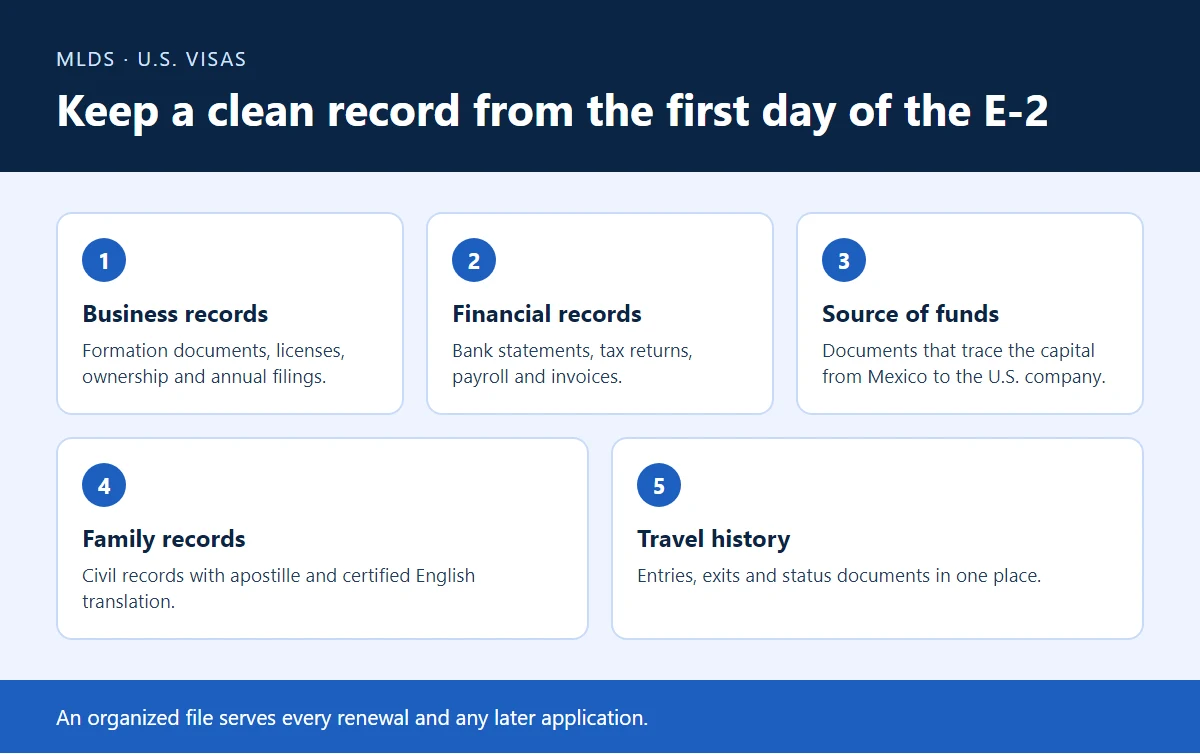
Keep the evidence for your E2 visa to green card plan organized from day one. That means company records, tax filings, payroll, leases, bank statements and proof of where the capital came from. A file that stays current makes every renewal and any later application easier to assemble.
- Business records: formation documents, licenses, ownership records and annual filings.
- Financial records: bank statements, tax returns, payroll and invoices.
- Source of funds: documents that trace the capital from Mexico to the U.S. enterprise.
- Family records: civil records with apostille and certified English translation.
- Travel history: entries, exits and status documents kept in one place.
Mexican documents that matter in the long run
Civil records, apostilles and translations appear in nearly every immigration step of an E2 visa to green card journey, so a clean set of Mexican documents pays off for years. Get them certified once and keep copies ready.
Family-based and employment-based applications both use civil documents such as birth and marriage certificates. Our guide to certified Mexican civil records explains how to obtain them, how to apostille Mexican documents covers legalization, and how to translate a birth certificate covers the English version.
If you manage property or accounts in Mexico while living abroad, a power of attorney helps. We explain it in our article on a power of attorney in Mexico. Errors in names, dates or places in civil records are the kind of detail that is easier to correct before a filing than during one.
How MLDS supports the E2 visa to green card journey
MLDS prepares the E-2 file, handles the Mexican documents and coordinates with an allied immigration attorney. For the E2 visa to green card question, the attorney reviews which general path could fit your situation, and MLDS keeps your documents ready.
We build the E-2 case for the E2 visa to green card journey in order: eligibility review, business plan with its numbers, proof of investment, Mexican documents and interview preparation. Along the way we organize the records so that they serve future renewals as well.
When the time comes to look at permanent residence, the attorney evaluates the category that fits your facts, and MLDS helps with the Mexican side: certified records, apostilles, translations and powers of attorney. To start, contact MLDS and tell us about your business and your family.
You may also find this useful: E2 Visa Cost.
Related guides: the minimum investment question for an E-2.
Frequently asked questions about the E2 visa to green card path
Can I apply for a green card while on an E-2 visa?
On the E2 visa to green card question, some E-2 holders become eligible for a green card through a category that has nothing to do with the E-2, such as family or employment. Eligibility depends on that category. An attorney can review your facts and tell you which category, if any, applies.
Does the E-2 count toward a green card?
In the E2 visa to green card sequence, the E-2 does not count as a step toward residence in itself. It is a temporary classification with its own purpose. USCIS describes the green card as a separate benefit requested under its own categories.
How long can I stay in the United States on an E-2?
For the E2 visa to green card timeline, initial stays are up to two years, and extensions can be granted in increments of up to two years each with no limit on the number of extensions, according to USCIS. The business must keep qualifying, and you must keep an intention to depart when the status ends.
Do my spouse and children get residence with me?
Spouses and unmarried children under 21 can accompany or follow an E-2 holder and generally receive the same period of stay. For a green card, family members are evaluated under the category that applies to the principal applicant, so the details depend on that category.
Sources: USCIS, E-2 Treaty Investors; USCIS, Green Card Eligibility Categories; USCIS, EB-5 Immigrant Investor Program; USCIS, EB-1 first preference.
Sigue leyendo: E2 visa requirements for Mexican citizens · Certified Mexican civil records