

The E2 visa minimum investment is the question almost every Mexican investor asks first, and the official answer surprises people: there is no fixed dollar figure. The State Department judges whether an investment is substantial by comparing it with the total cost of the business. This guide explains how that comparison works, which funds count and what makes an investment fall short.
We keep this article on the amount and the quality of the money. For the full document set, see our guide to the E2 visa business plan, which covers the sections and projections that support the investment.
Is there an E2 visa minimum investment?
No. The Foreign Affairs Manual states that no set dollar figure constitutes a minimum amount of investment for the E-2. The E2 visa minimum investment is relative: it depends on what the business costs and on whether your capital is enough to make it succeed.
The same manual describes a substantial investment as one that is substantial in a proportional sense, sufficient to ensure the investor’s financial commitment to the business, and of a magnitude that supports the likelihood that the investor will develop and direct it. Those three tests replace any magic number.
That is why you will find articles quoting different amounts. They are describing patterns they have seen, not a rule. When you plan your E2 visa minimum investment, work from the cost of your own business and from the evidence you can show.
How the proportionality test works
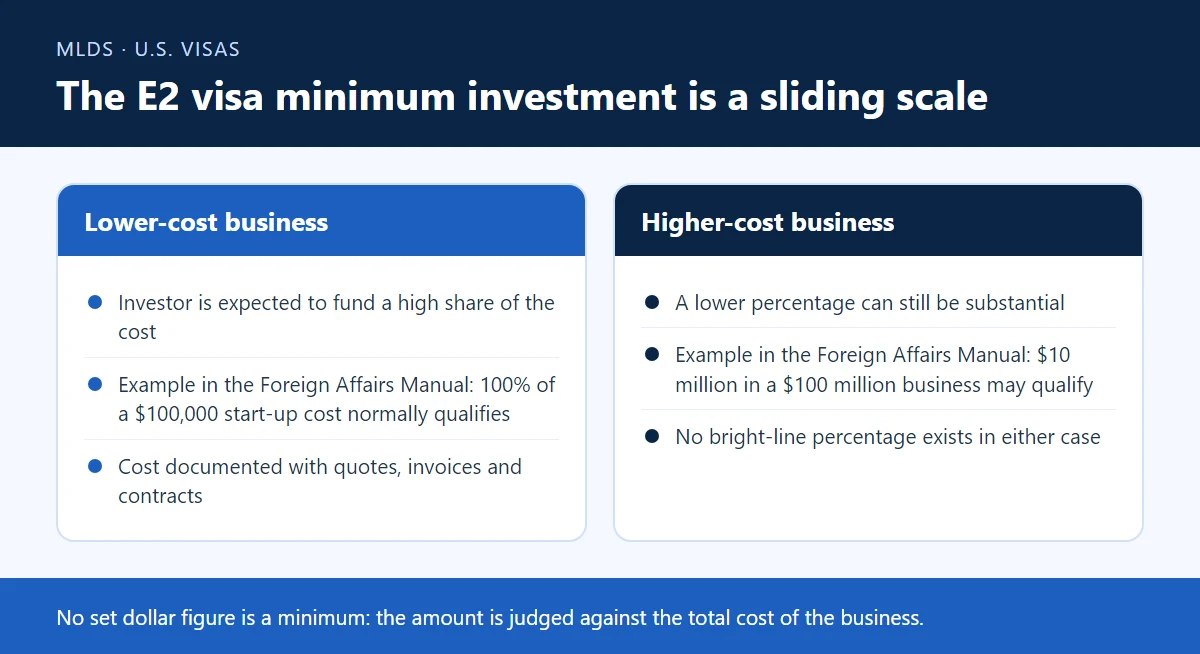
The proportionality test compares the qualifying funds you invest with the total cost of the business. The lower the cost of the business, the higher the percentage of it you are expected to invest, which the manual calls an inverted sliding scale.
The manual gives two examples at opposite ends. An investment of 100 percent of the total cost would normally qualify for a business with a start-up cost of $100,000. At the other extreme, $10 million invested in a $100 million business may be considered substantial because of the sheer size of the investment. It also states that there are no bright line percentages.
For a cheap business, then, the E2 visa minimum investment can mean funding nearly the whole cost. For an expensive one, a smaller share can be enough. The result is a judgment about your case, which is why a clear cost breakdown matters.
- Low-cost business: the expected share of the cost is high, close to the full amount.
- High-cost business: a lower percentage can still be substantial in absolute terms.
- Any size: the investment must also make the business likely to succeed.
How the cost of the business is measured
The cost is the base of the whole calculation, so it has to be documented. For an established business, the manual says the cost is generally its purchase price, normally the fair market value. For a new business, it is the actual cost needed to bring it to the point of being operational.
For a new company, the cost combines what you have already purchased with the estimates for the assets you still need. The manual lists evidence such as invoices or contracts for equipment and inventory, appraisals of land, buildings and machinery, accounting audits and records submitted to government authorities.
This is where the E2 visa minimum investment turns into paperwork. Every figure in the plan should trace to a quote, an invoice or a contract. Unverified financial statements based only on what the applicant says are normally insufficient, according to the manual.
Which funds count toward the E2 visa minimum investment
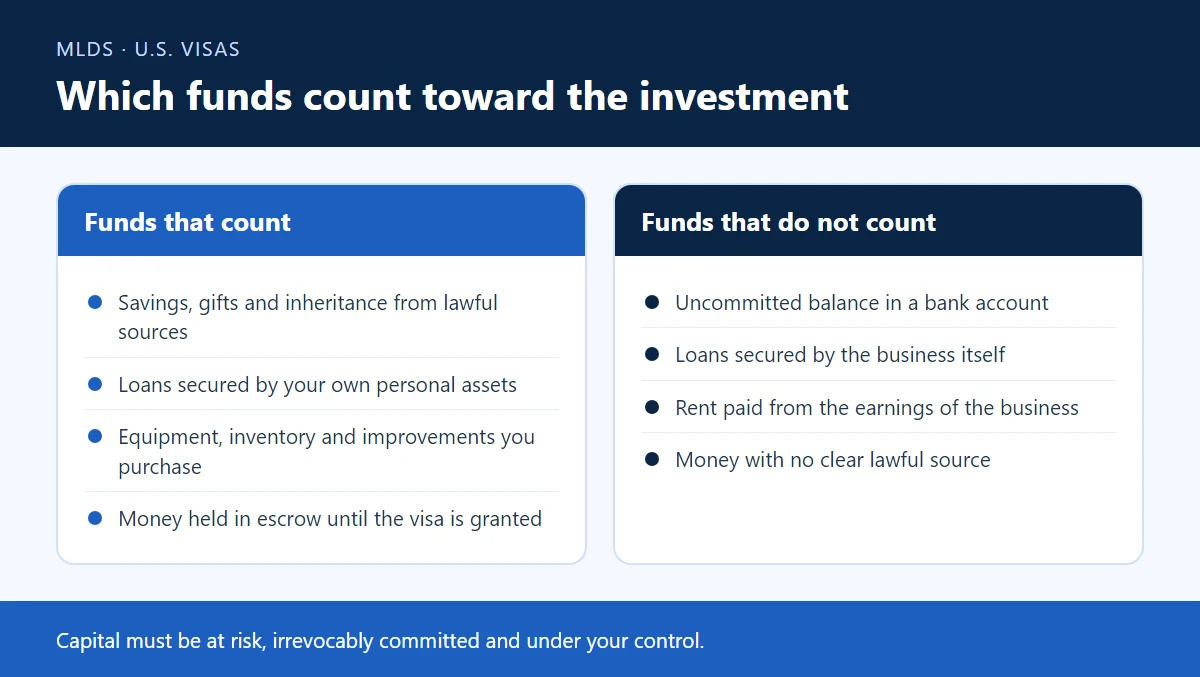
Only funds that are truly invested count toward the E2 visa minimum investment. The manual requires that the money be at risk, irrevocably committed and under your control, and that it did not come from illicit activity. The source can be legitimate savings, gifts, inheritance or other lawful sources.
Money at risk
An investment places capital at risk in the commercial sense, in the hope of a return. If the funds are not subject to partial or total loss when business fortunes reverse, they are not an investment. A non-profit does not qualify, and neither does a passive holding such as undeveloped land.
Irrevocably committed funds
To be in the process of investing, the funds must be committed and the commitment must be real. A purchase conditioned on the visa can still qualify if the money sits in escrow for release once the condition is met. Possession of uncommitted funds in a bank account does not suffice.
Borrowed money
The manual separates two cases. Commercial loans or mortgages secured by the assets of the business cannot count, because there is no risk to the investor. Debt secured by your own personal assets, such as a second mortgage on a home, or an unsecured loan on your personal signature, can be included.
Leases, equipment and intangibles
Lease or rent payments can count only for the amount devoted to that item in a month, unless rent is paid in advance. Equipment and inventory that you purchase count, as does machinery shipped to the United States, if it is used in an ongoing business. Intangible property can count to the extent its value can be determined.
What can make an investment fall short
An E2 visa minimum investment falls short when the amount is thin against the cost of the business, when the funds are not committed, when the enterprise looks marginal or when the file cannot show where the money came from. Each of these problems is visible to the officer.
- Uncommitted funds: a bank balance or a promise to invest later, with no contract, escrow or payment.
- Secured loans: money borrowed against the business itself, which carries no personal risk.
- Inheritance of a business: the manual says inheriting the business is not an investment in itself.
- Marginal enterprise: a company that cannot generate more than a minimal living for the investor and family.
- Unclear source: no paper trail from savings, sale of a property or company profits to the U.S. account.
The marginality point links back to your numbers. USCIS explains that a new enterprise can avoid the marginal label if it can generate more than a minimal living within five years of the start of E-2 status. A realistic projection is part of the E2 visa minimum investment story, not a separate topic.
Source of funds for Mexican investors
The source of the investment may be savings, gifts, inheritance, loans collateralized by your own assets or other legitimate sources, and it does not have to come from outside the United States. For Mexican investors, the practical task is documenting the path of the money.
Typical Mexican paperwork includes bank statements, the sale of a property, company records and tax filings. Documents in Spanish need translation, and some need an apostille. Our guides to certified Mexican civil records and to apostilles for Mexican documents explain how to order them from the United States.
Build the file as a timeline: where the money was, when it moved, which account received it and what it paid for. A clear timeline supports the E2 visa minimum investment more than a large number with no trail.
How to size your investment
Size your E2 visa minimum investment from the business outward. Define the cost, decide what you will commit before applying, and test the result against the three tests: proportional, committed and enough to make the business work.
- Step 1: price the business, with quotes, a purchase agreement or a build-out estimate.
- Step 2: list the qualifying funds you control and where each came from.
- Step 3: commit the funds, through payments or escrow tied to the visa.
- Step 4: check that the plan shows income beyond a minimal living within five years.
- Step 5: assemble the evidence in the order an officer will read it.
If the business is inexpensive, expect to fund most of it. If it is large, show how your share relates to the whole. In both cases the E2 visa minimum investment is built from documents, not estimated from a headline.
Frequently asked questions about the E2 visa minimum investment
Is $100,000 the E2 visa minimum investment?
No. The Foreign Affairs Manual uses $100,000 only as an example of a start-up cost where a full investment would normally qualify. It states that no set dollar figure is a minimum, so the amount depends on your business.
Can I invest after the visa is approved?
The funds must be invested or in the process of being invested, which means committed and irrevocable, before the visa decision. Escrow tied to the visa can keep the commitment real while the case is pending. A plan to invest later is not enough.
Does the E2 visa minimum investment change with the number of employees?
Not directly. The investment is compared with the cost of the business, and the number of employees is judged separately, in the context of the enterprise not being marginal. USCIS does not publish a fixed headcount for the E-2.
Can I use a loan to meet the E2 visa minimum investment?
Only some loans. Debt secured by your personal assets or an unsecured personal loan can be included because you risk the money. A loan secured by the business itself cannot count toward the investment.
Prepare your E2 file with MLDS
MLDS organizes the Mexican side of the file behind your E2 visa minimum investment: the civil and corporate documents, translations, apostilles and the order of the evidence, and it coordinates with an allied immigration attorney. We do not set the amount or promise a result, and we are a document-services firm that works with allied attorneys.
Read the E2 visa requirements for Mexican citizens first, then contact MLDS with your business idea and your timeline.
Sources: U.S. Department of State, 9 FAM 402.9 Treaty Traders, Investors, and Specialty Occupations and Treaty Trader and Treaty Investor visas; USCIS, E-2 Treaty Investors.
Sigue leyendo: E2 visa business plan · E2 visa requirements for Mexican citizens