

E2 visa processing time depends on several stages, not on a single office: preparing the file, filling out the DS-160, getting a consular appointment in Mexico, attending the interview and, for people already in the United States, a change of status with USCIS. Each stage has its own pace. This guide walks through them in order, shows what can slow a case down and explains how to keep your file ready.
We do not quote a number of weeks or months here, because official times change and vary by location and by case. Where an official source publishes a time, we point to it. If you are still checking whether you qualify, read our page on E2 visa requirements for Mexican citizens first.
The stages that make up E2 visa processing time
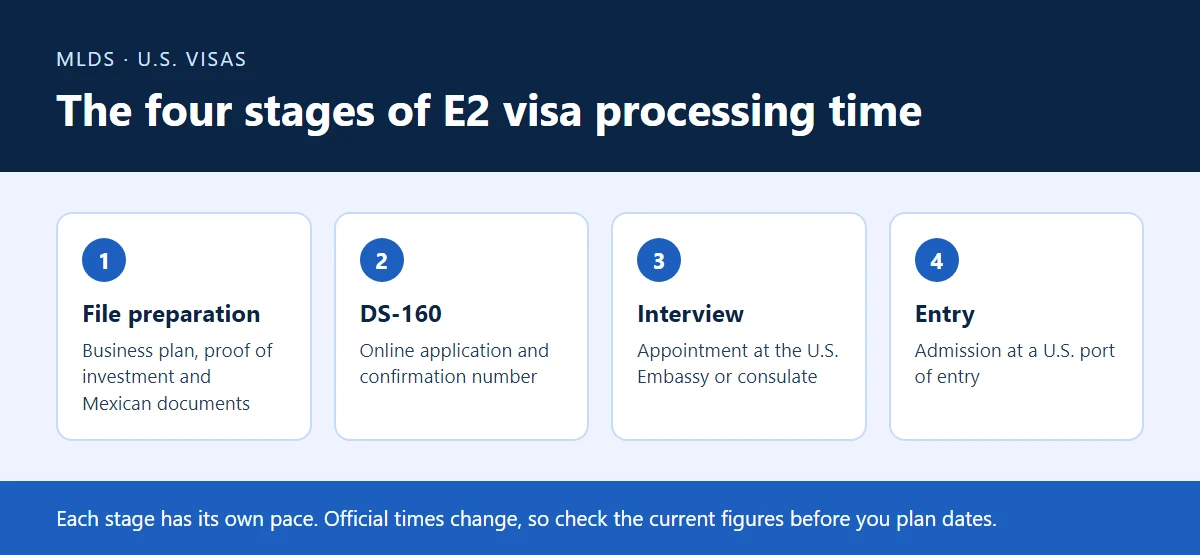
E2 visa processing time is the sum of four stages: building the file, submitting the DS-160, attending the consular interview and, once the visa is issued, entering the United States. The first stage is the one you control.
For a Mexican investor applying from Mexico, the E2 visa processing time sequence is usually this. First you prepare the case: business plan, proof of investment, source of funds and Mexican documents. Then you complete the online nonimmigrant visa application, the DS-160, and schedule the interview. After the interview, if the visa is issued, you seek admission at a U.S. port of entry.
- Stage 1, file preparation: business plan, investment evidence, company documents and Mexican records.
- Stage 2, DS-160: the online nonimmigrant visa application with its confirmation number.
- Stage 3, appointment and interview: scheduled with the U.S. Embassy or consulate for your country of residence or nationality.
- Stage 4, entry: after visa issuance, admission at a U.S. port of entry.
Stage 1: preparing the file before the E2 visa processing time starts
The longest part of E2 visa processing time is often the preparation, and it is the part you can shorten with good organization. A complete file at the start avoids returning to documents later.
USCIS explains that the investor must show a substantial amount of capital invested, or in the process of being invested, in a bona fide enterprise, with funds that have not been obtained through criminal activity. In practice that means a business plan, contracts, bank records and a clear trail of the origin of the money. The business plan we prepare with each client organizes those pieces into one document.
Mexican documents also take time because some come from civil registries, notaries or government offices. Certified civil records are explained in our guide on certified Mexican civil records, and legalization in how to apostille Mexican documents. Translations are covered in our guide to translating a birth certificate. Starting these early keeps the schedule in your hands.
Stage 2 and 3: DS-160, appointment and interview in Mexico
Once the file is ready, the E2 visa processing time moves to the consulate: you complete the DS-160, schedule your appointment and attend the interview in person. The U.S. Embassy in Mexico states that nonimmigrant applicants generally need an in-person interview with a consular officer.
The DS-160 and the appointment
The U.S. Embassy in Mexico explains that applicants interviewing at the Embassy must present a DS-160 confirmation number that matches the application number used to schedule the appointment. If the numbers do not match, the applicant may have to reschedule and pay new visa fees. This is why the DS-160 should be completed before an appointment is booked, and why a third party who reserved the slot must use the right number.
Applicants for U.S. nonimmigrant visas should schedule their interview at the U.S. embassy or consulate in their country of residence or nationality, according to the Embassy. Visa application fees are non-refundable and non-transferable, so it helps to confirm that your file is in order before paying.
The interview
In the interview stage of the E2 visa processing time, the consular officer reviews the whole file and asks about the business, the investment and your role. Bring your DS-160 confirmation page, your passport and the supporting documents. We prepare clients for the questions about the business before the consular appointment.
The Embassy lists the categories that can skip the interview, and the list focuses on other visa types such as certain A, G and NATO visas, and renewals of certain visitor and agricultural visas. Consular officers can still ask for an interview in any case. For a first-time E-2 applicant, plan on attending in person.
Appointment availability drives much of the E2 visa processing time. It is published by the State Department and changes over time. The Embassy page points applicants to the official wait-times tool and notes that applicants with an urgent need to travel may request an emergency appointment by following the guidance on its site. We do not predict a date, because the tool shows the current wait for each city.
If you are already in the United States: change of status with I-129
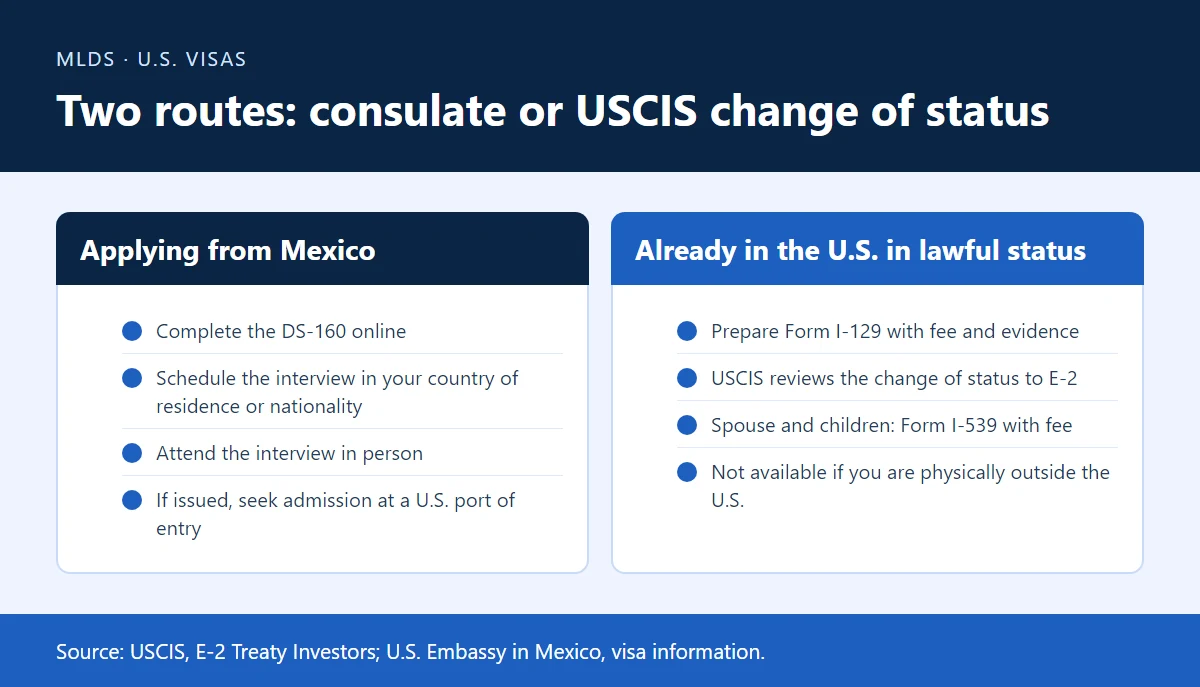
For E2 visa processing time inside the country, a person already in the United States in a lawful nonimmigrant status may ask USCIS for a change of status to E-2 by filing Form I-129, which makes the process a USCIS matter instead of a consular one. The processing time then follows USCIS.
USCIS states that if the treaty investor is currently in the United States in a lawful nonimmigrant status, they may file Form I-129 to request a change of status to E-2 classification. USCIS also says a request for E-2 classification may not be made on Form I-129 if you are physically outside the United States. In that case you apply for the visa abroad and then seek admission at a port of entry.
Spouses and children who are already in the United States and seek a change of status to an E-2 dependent classification may file a single Form I-539 with fee, according to USCIS. The regulation at 8 CFR 214.2(e) also states that the spouse and minor children of an applicant seeking a change of status file concurrent applications for change of status to derivative status.
The I-129 page on USCIS gives no fixed duration for the E-2 petition and sends filers to its Fee Schedule for the filing fee. Fees and times change, so check the official pages on the day you file and ask the attorney what applies to your case.
- Consular route: DS-160, appointment and interview at the U.S. Embassy or consulate.
- USCIS route: Form I-129 with fee and evidence, for people already in lawful nonimmigrant status.
- Family route: Form I-539 for dependents already in the United States.
What can add time to E2 visa processing time
Delays in E2 visa processing time usually come from the file, not from the person: missing evidence, inconsistent numbers, DS-160 mismatches or documents that need correction. Many of these can be avoided with an early review.
- Incomplete evidence: missing contracts, bank records or a clear source of funds.
- Inconsistent data: names, dates and amounts that differ between the business plan and the documents.
- Mismatched DS-160 number: the appointment was booked with a different application number.
- Document corrections: civil records with errors that must be corrected in Mexico before use.
- Unsigned or improperly signed forms: USCIS states it will reject or deny improperly signed forms.
- Late translation or apostille: documents that reach the file after the rest is ready.
A change in the business can also affect the case and the E2 visa processing time. USCIS states that a substantive change in the terms or conditions of E-2 status, such as a merger or acquisition, must be approved. If your plans change while the file is in progress, tell the attorney so the evidence stays aligned.
How MLDS helps keep your E2 visa processing time on track
MLDS cannot set the consulate’s or USCIS’s schedule, but it controls the part that is in the file: organized evidence, Mexican documents in order and an interview you are ready for. That is how E2 visa processing time stays predictable on our side.
We start the E2 visa processing time work with a case review and a document list. We prepare the business plan with its numbers, jobs and projections, organize the proof of investment and handle the Mexican documents: civil records, apostilles, powers of attorney and translations. An allied immigration attorney reviews the case before it goes to the consulate or to USCIS.
If you are traveling or working outside Mexico, a power of attorney can let someone act for you on local steps. We explain it in our article on a power of attorney in Mexico. To start, contact MLDS and tell us where you are in the process.
You may also find this useful: E2 Visa Cost.
Related guides: planning ahead for permanent residence after an E-2.
Frequently asked questions about E2 visa processing time
Can I speed up the E2 visa processing time?
You can shorten the part of the E2 visa processing time that you control: assemble the file early, check names and dates, finish translations and apostilles, complete the DS-160 correctly and request an emergency appointment only when the Embassy’s criteria apply. The consulate and USCIS set their own schedules.
Do I need to attend an interview in Mexico?
For a first E-2 application, plan to attend in person. The Embassy states that nonimmigrant applicants generally require an in-person interview, with specific exceptions that do not include a first E-2 application. Consular officers may also require an interview on a case-by-case basis.
What if I am already in the United States?
If you hold a lawful nonimmigrant status, you may be able to request a change of status with Form I-129, as described by USCIS. If your status has ended, ask the attorney which route applies.
How long can I stay once the visa is approved?
USCIS states that the maximum initial stay is two years and that extensions may be granted in increments of up to two years each, with no limit on the number of extensions. All E-2 nonimmigrants must maintain an intention to depart when their status ends.
Sources: USCIS, E-2 Treaty Investors; USCIS, Form I-129; U.S. Embassy in Mexico, visa information; eCFR, 8 CFR 214.2.
Sigue leyendo: E2 visa requirements for Mexican citizens · How to apostille Mexican documents