

An E2 visa business plan is the document that tells the consular officer what your company is, where the money goes, how many people it will employ and why it can grow past a minimal living for you and your family. For Mexican investors, it is usually the piece that decides how strong the whole file looks. This guide explains what the plan should contain, how to build the numbers and which mistakes slow cases down.
The E-2 classification is for a national of a treaty country who invests a substantial amount of capital in a real U.S. business and comes to the United States to develop and direct it. Our page on E2 visa requirements for Mexican citizens covers eligibility. This article goes deeper on the plan itself.
What an E2 visa business plan has to prove
An E2 visa business plan must show three things: the investment is real and at risk, the business is an active enterprise, and the company can do more than provide a minimal living. Every section of the plan supports one of those points.
USCIS describes the E-2 investor as someone who has invested, or is actively in the process of investing, a substantial amount of capital in a bona fide enterprise, and who enters solely to develop and direct it. The federal regulation at 8 CFR 214.2(e) adds that the capital must be subject to partial or total loss if the business fails. A good E2 visa business plan keeps those words in view from the first page.
Think of the E2 visa business plan as a story told with documents. The executive summary names the owner and the company, the market section shows demand, the operations section shows how the doors open, and the financial section shows the numbers. Each part points to evidence in the file, such as contracts, leases, bank records and invoices.
- Real investment: the plan lists what has been spent or irrevocably committed and what remains to be spent.
- Active business: the plan describes products or services, customers, suppliers and the location where work happens.
- Growth capacity: the plan projects income, payroll and expenses over five years.
- Owner role: the plan shows that you hold at least 50% ownership or operational control and will direct the company.

Sections to include in your E2 visa business plan
A complete E2 visa business plan usually has eight sections: executive summary, company description, products and services, market analysis, operations and staffing, marketing, financial projections and use of funds. The order can change, but each section should answer a question the officer is likely to ask.
Executive summary and company description
Open with one page that states the business type, the legal entity, the location, the owner and the amount invested. Follow with a company description that covers the formation date, ownership split and the role you will hold. If you are buying an existing business, describe its history and what you plan to change after the purchase.
Products, market and competition
Describe what the company sells, who buys it and why customers choose it over nearby alternatives. Local data helps: population around the location, traffic, competitors within a reasonable radius and the price range in the area. A plan for a restaurant, a franchise or a service company reads very differently from a generic template, and officers notice the difference.
Operations, staffing and marketing
Explain the daily operation: opening hours, suppliers, equipment, licenses and the people who will do the work. Include an organization chart that shows where you sit as owner and director and which roles you will hire. The marketing section lists the channels you will use, such as local advertising, a website, delivery platforms or partnerships, with the budget for each.
Financial projections and use of funds
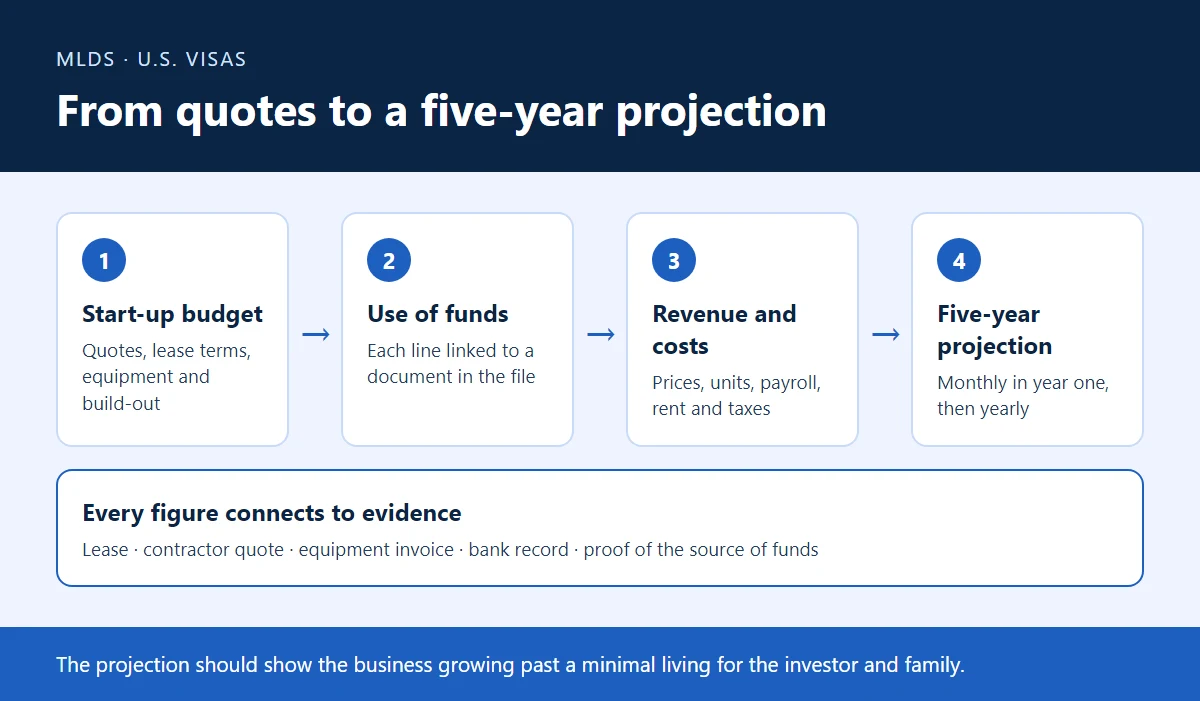
This is the section officers read most closely. It carries a start-up budget, a use-of-funds table, a monthly forecast for the first year and an annual forecast through year five. Each figure should connect to something in the file, such as a lease, a quote from a contractor or an invoice for equipment.
How to build the numbers in an E2 visa business plan
The numbers in an E2 visa business plan should come from real quotes, lease terms and market data, then flow into a five-year projection that shows the company growing past a minimal living. Round figures with no source tend to raise questions.
Start with the total cost of the enterprise. USCIS explains that the investment must be substantial in relation to the total cost of buying an established business or creating a new one, and that the lower the cost of the enterprise, the higher, proportionately, the investment must be. That means your E2 visa business plan should present the total cost first and show the share you have already committed.
Then list each use of funds: equipment, build-out, inventory, licenses, deposits, marketing and working capital. Attach support for each line. Funds placed in escrow can count as committed when they are irrevocably committed to the enterprise, as the regulation describes, so many investors structure the payment that way while the visa is pending.
- Start-up budget: every purchase with its supplier, quote date and amount.
- Revenue forecast: units or services sold, price and growth assumptions for each year.
- Cost forecast: rent, payroll, taxes, insurance, supplies and professional fees.
- Profit and cash flow: month by month in year one, then yearly through year five.
- Owner income: what the business can pay you after covering its own costs.
Jobs, the five-year projection and the marginal enterprise test
The business cannot be marginal, so the five-year projection in your E2 visa business plan should show income beyond a minimal living, with hiring that supports the growth. USCIS and the regulation both use a five-year horizon for new businesses.
A marginal enterprise is one that cannot generate more than enough income to provide a minimal living for the investor and family. For a new company that lacks that capacity today, the regulation says it should be realizable within five years from the date the E-2 status begins. A company with a present or future capacity to make a significant economic contribution is not marginal.
Hiring is part of that story. Your plan should list the roles, the start month of each hire and the payroll cost. USCIS does not publish a fixed number of employees for the E-2, so the number must make sense for your type of business. A staffing table that matches the revenue forecast is more persuasive than a large headcount with no logic behind it.
Show the projection of your E2 visa business plan in three scenarios if you can: conservative, expected and optimistic. The conservative case should still show a viable company. When every scenario holds up, the plan answers the marginality question before it is asked.
Common mistakes that weaken an E2 visa business plan
The most common weaknesses in an E2 visa business plan are a copied template, numbers that do not match the evidence, an investment that is low compared with the total cost and an owner role that does not show control. Each one can be fixed before filing.
- Template text: a plan that could describe any company in any city tells the officer nothing about yours.
- Mismatched figures: the plan says one amount and the bank records say another.
- Unclear source of funds: the file does not trace the money from savings, a property sale or company profits to the U.S. account.
- Thin investment: capital that is small against the total cost of the business.
- Missing owner role: the plan does not show 50% ownership or operational control and the duties you will perform.
- Unrealistic growth: a curve that jumps with no hiring or marketing spend to explain it.
Origin of funds deserves special attention. The regulation requires that the capital has not been obtained, directly or indirectly, through criminal activity, and the consulate reviews where the money comes from. Mexican investors often document savings, the sale of a property in Mexico, company profits or an inheritance, which brings Mexican documents into the file.
Mexican documents that support the plan
Your E2 visa business plan is backed by documents, and for Mexican investors many of them come from Mexico: civil records, corporate records, powers of attorney and translations. Preparing them early keeps the file moving.
Common examples include certified civil records, which we cover in our guide to certified Mexican civil records, apostilled corporate or property papers (see how to apostille Mexican documents), and powers of attorney used to sell property or manage assets while you are abroad, explained in our article on a power of attorney in Mexico.
Documents in Spanish need translation into English. If a birth or marriage certificate is part of the file, our guide on how to translate a birth certificate shows the usual route. Keeping the names, dates and amounts consistent across the plan and these documents prevents avoidable questions at the interview.
How MLDS builds your E2 visa business plan
MLDS prepares the full file around your E2 visa business plan: it organizes the plan with its numbers, jobs and projections, gathers proof of investment, handles the Mexican documents and coordinates with an allied immigration attorney before the file is filed.
We start with a case review: your business idea or the company you plan to buy, the capital you have, where it comes from and what you have already committed. From there we define the sections of the plan, the supporting evidence and the Mexican documents required.
The plan is built from your own information. You provide quotes, leases, financial statements and ownership details; we organize them into a structured document and check that the figures match the evidence. The specialist reviews the case before it goes to the consulate or to USCIS, and we prepare you for the questions about the business at the interview.
When you are ready, contact MLDS and tell us about your business, or review the E2 visa requirements first.
You may also find this useful: E2 Visa Cost.
Related guides: the stages and delays of an E-2 case.
Frequently asked questions about the E2 visa business plan
How long should an E2 visa business plan be?
Length follows the business. A small service company may need a focused plan, while a franchise or an acquisition needs more detail on operations and financials. USCIS does not set a page count, so the right length is the one that answers every question about the investment, the operation and the projection.
Do I need a business plan if I am buying an existing company?
Yes. A purchase still needs a plan that explains the history of the business, what you will do with it and how it will grow. The regulation lists a comprehensive business plan among the evidence for new enterprises, and for a purchase the plan shows how you will develop and direct what you bought.
Can the E2 visa business plan be updated later?
Yes. The plan is a working document, and your numbers will change as you sign leases and place orders. For extensions, USCIS allows E-2 stays in increments of up to two years, and an updated plan with real results helps show that the business is operating.
Is the E2 visa business plan enough on its own?
No. The plan sits alongside proof of investment, proof of the source of funds, company records and your identity documents. Together they show that the capital is committed and the business is real.
Sources: USCIS, E-2 Treaty Investors; eCFR, 8 CFR 214.2; U.S. Embassy in Mexico, visa information.
Sigue leyendo: E2 visa requirements for Mexican citizens · Certified Mexican civil records