

An E2 visa lawyer is one of the biggest decisions in an investor case, because the professional you choose shapes how the file is built. This guide explains when working with an E2 visa lawyer makes sense, what the lawyer does, who is allowed to represent you before USCIS and how to compare candidates. It is written for Mexican investors planning a U.S. business.
MLDS is a document-services firm that works with allied attorneys. We prepare the Mexican side of the file and coordinate with an allied immigration attorney, so this article focuses on how to choose well rather than on handling your case for you.
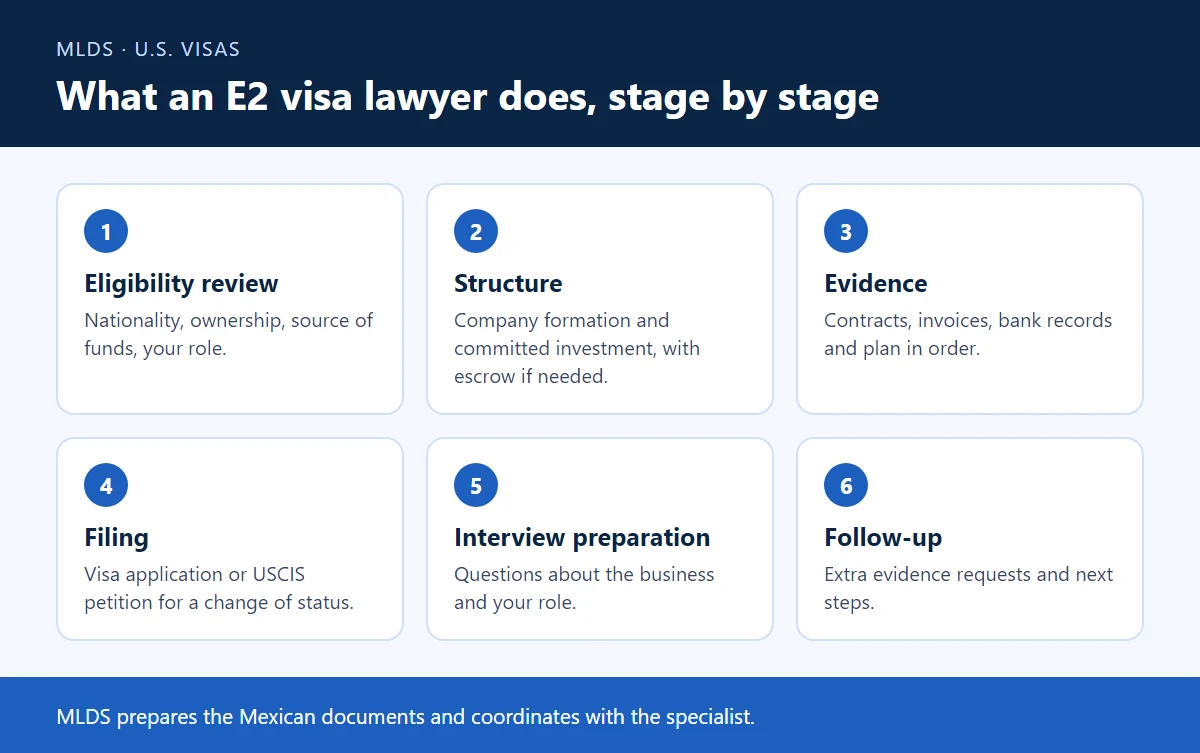
What does an E2 visa lawyer do?
An E2 visa lawyer reviews whether your case meets the E-2 requirements, helps structure the investment and the company, organizes the evidence and prepares you for the consular interview or for a USCIS filing. The goal is a file that answers the questions before the officer asks them.
The E-2 has several elements that interact: treaty nationality, a substantial and committed investment, a real and active enterprise, ownership or control, and an enterprise that is more than marginal. A good lawyer looks at how those pieces fit together in your facts, not one at a time.
- Eligibility review: nationality, source of funds, ownership and the role you will hold.
- Structure: how the company is formed and how the investment is committed, including escrow while the visa is pending.
- Evidence: contracts, invoices, bank records and the business plan, in an order the officer can follow.
- Forms and filing: the visa application or, for a change of status, the USCIS petition.
- Interview preparation: the questions an officer may ask about the business and your role.
When an E2 visa lawyer is worth considering
Most investors benefit from an E2 visa lawyer when the case has moving parts: more than one owner, a business purchase, borrowed money, a change of status inside the United States or employees who will also need visas. Simple cases can be easier, but the cost of a weak file is high.
The Foreign Affairs Manual shows why structure matters. Control is normally shown through at least 50 percent ownership, but it can also come from operational control. An equal partnership with more than two partners does not give any of them control by ownership. A lawyer can spot those issues before you sign anything.
- Several owners: the ownership split decides who can qualify as the investor.
- Dual nationals: the manual says a business may have only one qualifying nationality, so a choice must be made.
- Financing: loans secured by the business do not count toward the investment, while debt secured by your personal assets can.
- Business purchase: the cost is generally the purchase price, and escrow can keep the commitment real while the visa is pending.
- Earlier refusals: a prior denial or a gap in the story calls for a careful review before reapplying.
Timing is part of the decision. The earlier a professional sees the case, the more options you have: the company can be formed with the right ownership, the purchase agreement can include escrow tied to the visa, and the documents can be ordered from Mexico while you compare candidates. Waiting until the money is already spent leaves fewer choices.
If your situation is straightforward and you are comfortable preparing documents, you can still ask a lawyer to review the finished file. A review is a smaller commitment and can catch mismatches between the plan, the contracts and the bank records.
Who can represent you before USCIS
Only certain people can represent you before USCIS: licensed U.S. attorneys in good standing, accredited representatives of organizations recognized by the Department of Justice, and, under supervision, law students and graduates. Foreign attorneys can represent clients only for matters outside the United States.
USCIS also explains that other helpers may assist with forms for a nominal fee but cannot represent you or give legal advice. Before you hire anyone, confirm the license. The agency recommends using the American Bar Association directory, checking the state licensing agency and asking to see the current license.
The same page warns about notary scams. In some countries a notario público is a licensed attorney, but in the United States a notary public is not an attorney and cannot represent you in immigration matters. Mexican investors are a frequent target of this confusion, so ask directly: are you a licensed attorney in a U.S. state?
Read the agency’s own guidance on finding legal services, which also explains how to report misconduct to the state bar or to DHS Disciplinary Counsel.
How to choose an E2 visa lawyer
To choose an E2 visa lawyer, compare experience with investor cases, communication, the written scope of work and how fees are structured. Ask the same questions to each candidate so the answers are comparable, and keep the replies in writing.
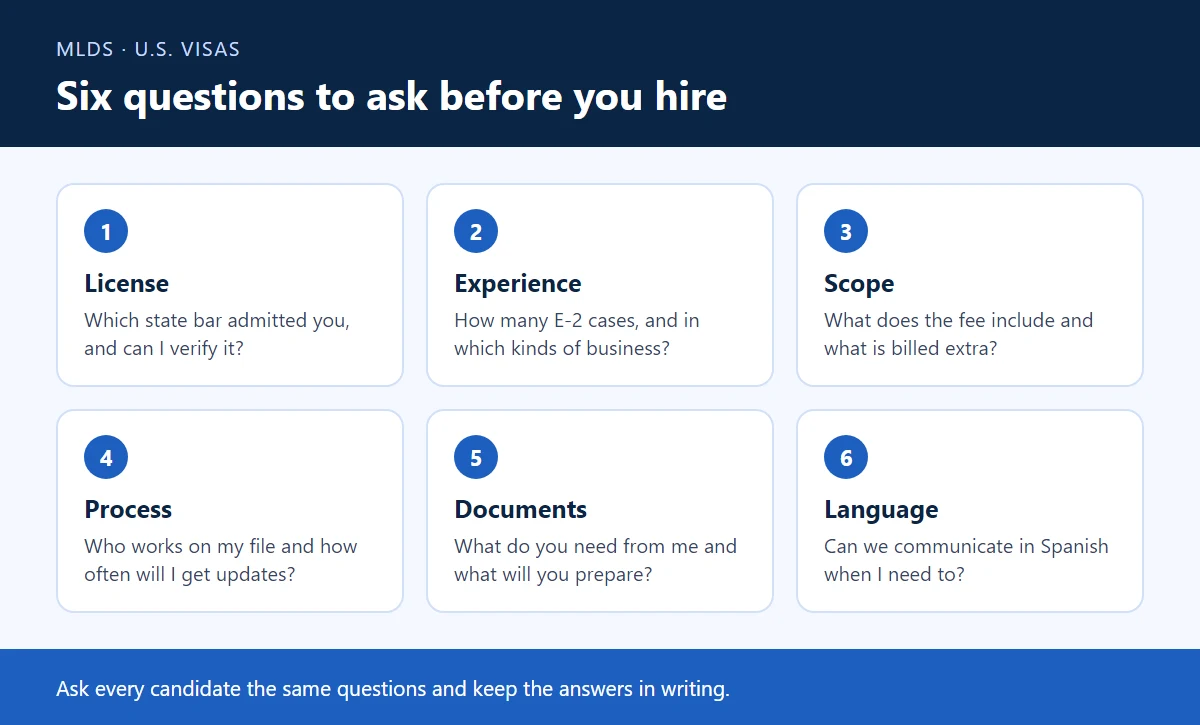
- License: Which state bar are you admitted to, and can I verify it?
- Experience: How many E-2 cases have you handled, and in which kinds of business?
- Scope: What is included in the fee, and what is billed separately?
- Process: Who will work on my file, and how often will I receive updates?
- Documents: What do you need from me, and what will you prepare?
- Language: Can we communicate in Spanish when I need to?
Hold a first conversation with two or three candidates before you decide. Bring a one-page summary of your business, the amount you expect to commit, where the funds come from and who will own the company. How a professional reacts to that summary tells you a lot: whether they ask about the source of funds, the ownership split and the timeline, or move straight to a price. Questions about your facts are a good sign, because they show the professional is reading your case and not applying a template to it.
Fees are the part investors worry about most, and there is no official price list. Ask whether the fee is flat or hourly, what happens if the consulate asks for more evidence and when each payment is due. Place those fees in a full budget that also includes the investment, the government fee and your documents.
Pay attention to how a candidate talks about results. The consular officer decides the case, so nobody can promise approval. A serious professional explains risks, the evidence needed and what could weaken the file.
Warning signs when hiring an E2 visa lawyer
The main warning signs are a guarantee of approval, a refusal to show a license, vague fees and pressure to invest before the case is reviewed. Any of them is a reason to pause and compare other options.
- Guaranteed results: no one controls the officer’s decision.
- Unclear license: the person avoids naming a state bar or asking you to verify it.
- Notary titles: someone presents a notary public as if it were a law license.
- Rushed investment: pressure to commit funds before the structure has been reviewed.
- Open-ended fees: no written scope, no explanation of what is billed extra.
The investment itself is also at risk by definition, so a decision to commit capital should follow a review of the business and the file, not precede it.
How MLDS works alongside an E2 visa lawyer
MLDS prepares what an E2 visa lawyer needs from Mexico: certified civil records, apostilled corporate or property papers, powers of attorney and translations. We keep the originals organized, track what is pending and coordinate with the attorney who reviews your case.
That division keeps each person in their role. The attorney handles the immigration strategy, and MLDS handles the Mexican documents and the logistics. For the documents most investors need, see our guides to certified Mexican civil records and to the E2 visa business plan.
If you are already working with an E2 visa lawyer, we can work from the document list they give you. If you are still looking, contact MLDS and tell us about your business so we can coordinate with an attorney.
Frequently asked questions about the E2 visa lawyer
Do I need an E2 visa lawyer?
The E-2 is a decision by a consular officer or by USCIS, and many investors choose professional help because the file combines business, financial and immigration questions. Whether you need one depends on how complex your case is and how comfortable you are with the evidence.
Can a notary public act as my E2 visa lawyer?
No. USCIS states that in the United States notary publics are not attorneys and cannot represent you in legal matters, including immigration cases. Only licensed attorneys and accredited representatives, among others, can represent you before the agency.
How do I verify an E2 visa lawyer?
Ask for the state where the lawyer is licensed and check that state’s licensing agency. USCIS also points to the American Bar Association directory and to Department of Justice lists of recognized representatives and disciplined practitioners.
Should my E2 visa lawyer be in Mexico or in the United States?
USCIS says foreign attorneys can represent you only for matters outside the United States. For a filing with USCIS you need a U.S. licensed attorney or an accredited representative. For a consular application, ask each candidate how they handle your case.
Talk to MLDS before you choose
Choosing an E2 visa lawyer is easier when your documents and your business story are already organized. MLDS can review what you have, list what is missing and prepare the Mexican paperwork while you compare candidates.
Start with the E2 visa requirements for Mexican citizens, then write to us through the contact page.
Sources: USCIS, Find Legal Services and E-2 Treaty Investors; U.S. Department of State, 9 FAM 402.9.
Sigue leyendo: E2 visa requirements for Mexican citizens · E2 visa business plan