

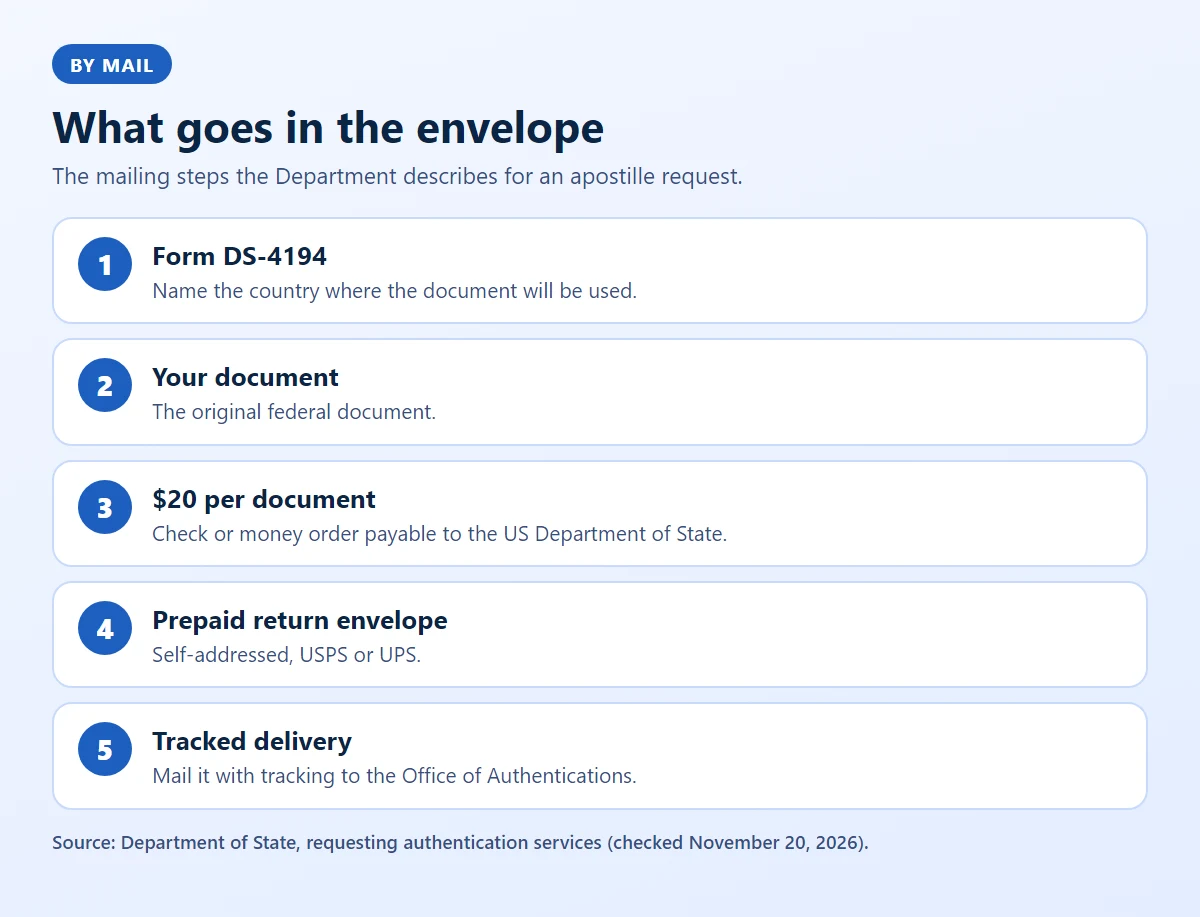
A US Department of State apostille is the certificate the Office of Authentications attaches to a document issued by a federal agency so another Apostille Convention country accepts it. You mail the original with Form DS-4194, a $20 fee for each document and a prepaid return envelope.
Tell us the document and the Mexican procedure. We tell you whether the federal route or a state office applies, and what the Mexican side usually asks for.
What a US Department of State apostille covers
A US Department of State apostille covers federal documents: the paper is issued or signed by a federal official, so no state Secretary of State can authenticate it. The HCCH list of US competent authorities states that the Office of Authentications issues apostilles for documents issued by federal agencies of the United States.
Two federal exceptions exist on the same list. The Vital Records Section of Passport Services issues apostilles for consular reports of birth, death and marriage, and the clerks of federal courts issue apostilles for documents issued by those courts. Everything else of federal origin goes to the Department of State.
Federal or state: how to know which office you need
The signer of the document tells you the office. A paper signed by a state or county official, or by a notary, goes to the Secretary of State of that state. A paper issued by a federal agency goes to the Department of State.

| Document | Office that apostilles it | Why |
|---|---|---|
| FBI Identity History Summary | US Department of State | The FBI is a federal agency and the FBI states that only the Department of State apostilles its results |
| Federal court judgment or order | Clerk of that federal court | The HCCH list assigns federal court documents to the clerks |
| Consular report of birth abroad | Passport Services, Vital Records Section | The HCCH list names that unit |
| Birth, marriage or death certificate from a state | Secretary of State of that state | The state is the issuing authority |
| Power of attorney signed before a notary | Secretary of State of the notary’s commission state | The apostille authenticates the notary |
A federal agency paper that you notarized, or that a state office certified, can need a state step before a federal one, or a different office altogether. Ask the receiving office which version it wants before you send anything.
Step by step: how to get a US Department of State apostille
The mail route has six steps. Prepare the original, complete Form DS-4194, add the payment, add a return envelope, mail it with tracking and then check the result.
- Confirm the document is federal. Use the table above; state and notarized papers go to a state office.
- Complete Form DS-4194. It asks for the country where the document will be used.
- Pay the fee. The Department’s page says $20 for each document, by check or money order made out to the US Department of State, with your name and address printed in the upper left corner and a check number over 100. Cash and credit card information are not accepted by mail.
- Add a prepaid return envelope. The page asks for a self-addressed, prepaid USPS or UPS envelope.
- Mail it with tracking. The address is Office of Authentications, 44132 Mercure Circle, PO Box 1206, Sterling, VA 20166-1206.
- Receive and check it. Confirm that the apostille is attached and that the destination country matches the form.
We help you decide whether the federal route applies, order the steps and prepare the Mexican records that the same procedure needs.
What a US Department of State apostille costs and how long it takes
The Department lists $20 for each document, and it says it cannot refund the fee under federal law. For a package with three federal documents, the apostille fees are therefore $60, plus any cost of obtaining the documents themselves.
On timing, the Department’s page says that when the trip or the deadline is five weeks away or more, you send the request by mail, and that the Department processes it within five weeks from the day it receives it. For shorter timelines the page points to in-person drop-off, so read the current options on the Department’s page on requesting authentication services before you decide.
A citizenship, wedding or property file often combines a federal record, a state certificate and a notarized statement. We help you order every US Department of State apostille and state apostille so the Mexican office receives one coherent file.
The FBI report: the most common US Department of State apostille
The most common federal document that needs a US Department of State apostille is the FBI Identity History Summary, often called a criminal background check. The FBI’s own FAQ says it does not issue apostilles: it authenticates the results with its watermark and a division official’s signature, and you then send them to the Department of State when an apostille is needed.
The FBI also says that a channeler, a private company approved to submit requests on your behalf, handles only requests that do not need an apostille, and that requests to authenticate previously processed results are not accepted. The Spanish-language guide to the criminal record letter from the United States covers the same document in more detail.
How to keep a federal apostille request under control
Treat the request like a small project with three records: what you sent, when you sent it and what you expect back. A photocopy of every document, kept before mailing, lets you answer questions from the receiving office while the originals are away.
- Copy first: scan each page of the document and of Form DS-4194 before the envelope is sealed.
- Track the package: keep the tracking number for the outgoing envelope and for the prepaid return envelope.
- Work backwards from the deadline: the Department says mailed requests are processed within five weeks of receipt, so add the delivery time on both legs.
- Tell the Mexican office what your US Department of State apostille package will include: ask whether it needs the original with the apostille attached, a certified translation or both.
Keep the original safe on its way back. The FBI states that it does not accept requests to authenticate results it has already processed, so a lost report means ordering a new one before another apostille request.
What a US Department of State apostille is not
A US Department of State apostille does not approve the content of your document, does not translate it and does not replace a state apostille. It confirms the signature and seal of the federal official, nothing more, so the receiving office still decides whether the document answers its question.
It also does not stand in for the steps that come before it. If a federal paper has errors, the agency that issued it has to correct them; the Office of Authentications authenticates what it receives. Check names, dates and numbers on the original before the envelope leaves your hands, because a correction after the apostille means starting over.
If the destination is not an Apostille Convention country
The Department explains that apostille certificates are for countries in the 1961 Hague treaty and authentication certificates are for countries that are not. A US Department of State apostille therefore depends on the destination appearing on the HCCH status table, which lists 130 contracting parties as of June 30, 2026 and includes Mexico.
If the country is not on the table, ask its consulate or the receiving office what it wants after the authentication certificate, since each country sets its own rules. The entry-into-force date in the table also matters: a country that has deposited its accession but is not yet in force does not apply the Convention.
Using a US Department of State apostille in Mexico
Mexico has been a contracting party to the Apostille Convention since August 14, 1995, according to the HCCH status table, and the United States since October 15, 1981. A US Department of State apostille on a federal document is therefore the certificate the Mexican office expects.
The receiving office decides whether it also wants a Spanish translation, and from whom. For how the apostille fits into a Mexican file, see our guide on Mexican documents for immigration and the explanation of how to apostille Mexican documents, which covers the opposite direction.
Mistakes that delay a US Department of State apostille
The usual delays come from the envelope and from the choice of office, not from the Department.
- The document is federal, not a state or notarized paper
- Form DS-4194 names the destination country
- The payment is a check or money order, with a check number over 100
- The envelope includes a prepaid return label
- The package was mailed with tracking
- The receiving office was asked whether it wants a translation
A last point is the order of steps for mixed files. If a federal record has to be copied, notarized or translated before it is sent, do those steps only when the receiving office asks for them. Each extra step is another place for a name to be spelled differently.
Related guides: the Texas Secretary of State walk-in rules.
FAQ: US Department of State apostille
How much is a US Department of State apostille?
The Department lists $20 for each document, and the fee cannot be refunded under federal law. Confirm the amount on the Department’s page before you mail the request.
Can the Department of State apostille a state birth certificate?
No. A state birth certificate is apostilled by the Secretary of State of the state that issued it. The Department handles documents issued by federal agencies.
Does an FBI background check need a US Department of State apostille?
When the receiving office asks for an apostille, yes. The FBI states that it authenticates the results and that you send them to the Department of State for the apostille.
Is a US Department of State apostille valid in Mexico?
Yes, for a federal document. Mexico is a contracting party since August 14, 1995, so the apostille is the certificate the Mexican office expects.
Can MLDS obtain the apostille for me?
No. The apostille comes from the Department of State or from the state office that applies. MLDS guides you on preparing the paper for Mexico and handles the Mexican records connected to your procedure.
How MLDS helps after the US Department of State apostille
A US Department of State apostille solves one step. The Mexican procedure around it still needs certified records, corrections when a name or date does not match, and a clear order of documents. MLDS coordinates the Mexican side and orients you on the rest.
Write to us from the contact page with the procedure, the federal document and the Mexican office, and we reply with the steps that fit your case.
Keep going with our guides on FBI background check apostille and Hague Convention countries.