

Mexican divorce law has changed a great deal in the last twenty years, and many people living in the United States still picture a process where one spouse must prove fault. Today a spouse can ask for a divorce without giving a reason. This guide explains the no-fault rule, the two routes, property, support and children, so you know what to expect.
What Mexican divorce law says today
Under Mexican divorce law, a marriage can be dissolved at the request of one or both spouses without naming a cause. Mexico City’s Civil Code says it plainly: a spouse only has to tell the judge that they do not want to continue the marriage.
Mexico has a federal Civil Code and a code for each state, so the text changes with the place. The Civil Code for Mexico City is the clearest example of the modern rule, and it is the one quoted in this guide.
No-fault divorce in Mexican divorce law
No-fault divorce, called divorcio incausado or divorcio sin expresión de causa, means the judge does not ask why the marriage ended. One spouse can make the request alone, and the consequences for children, support and property are still decided.
The Supreme Court reached this idea through the free development of personality. In a ruling that quotes its contradiction of theses 73/2014, the court said that forcing a person to prove a cause in order to end a marriage interferes with that right. You can read the reasoning in the Supreme Court ruling on amparo 3319/2016.
The same text adds that the only outer limits of that right are public order and the rights of other people. That is why children, support and property are always settled, even when nobody has to explain the reason for the divorce.
Administrative divorce versus judicial divorce
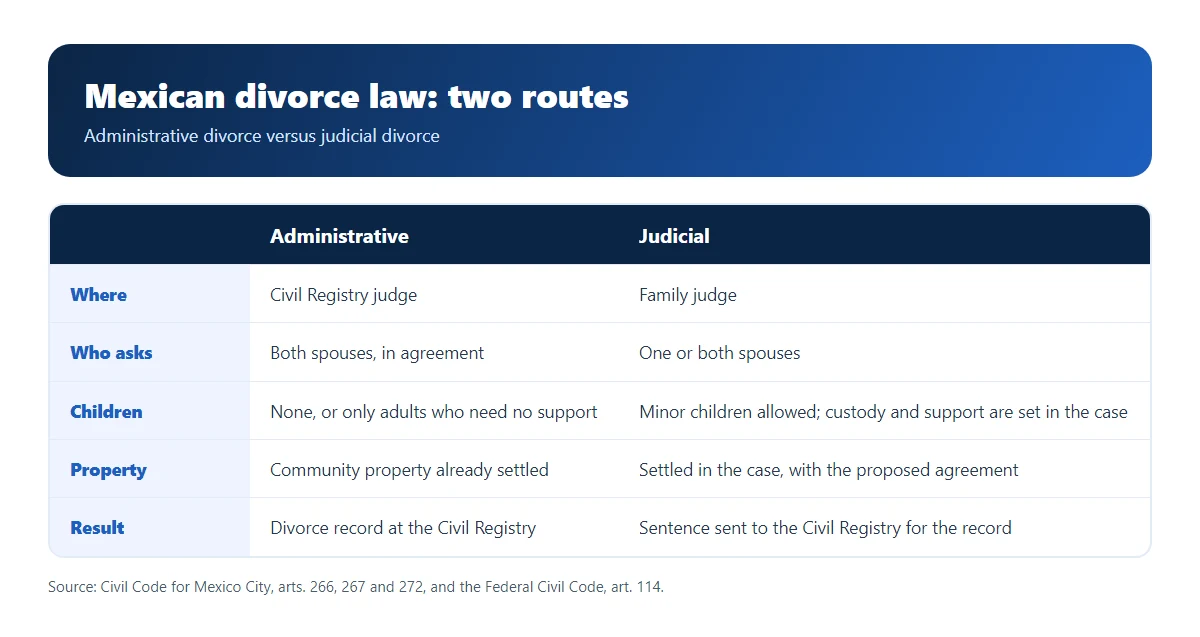
Mexican divorce law offers two routes. The administrative divorce is done before the Civil Registry when both spouses agree and meet the conditions. The judicial divorce goes before a family judge when one spouse asks alone or when the conditions are not met.
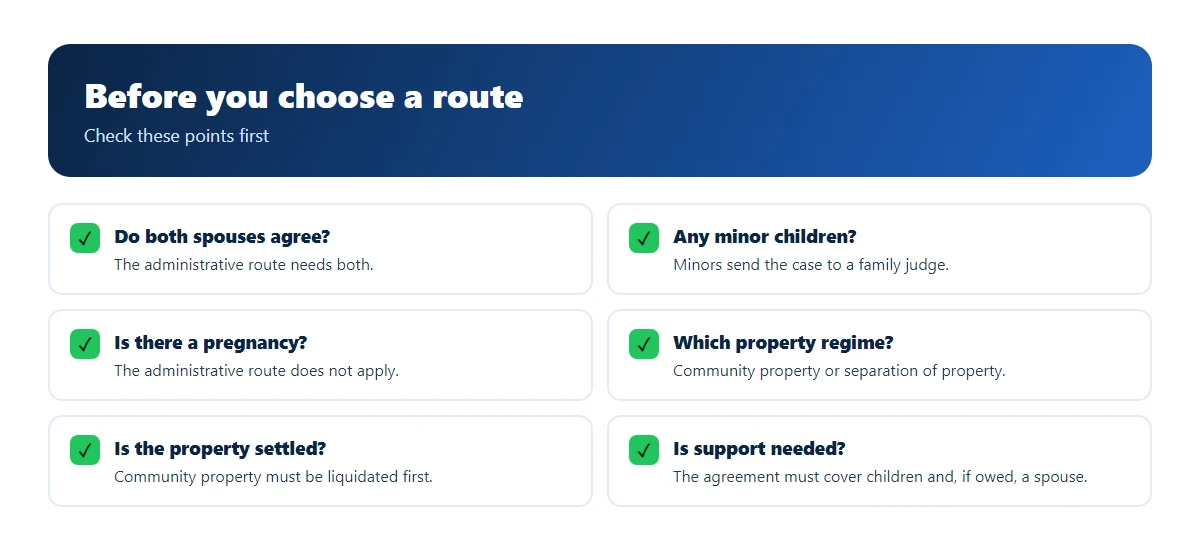
The administrative route has conditions. According to the Mexico City code, both spouses must agree, the community property must be settled if they married under that regime, the wife must not be pregnant, and they must have no children together or only adult children who do not need support.
In that case, the Civil Registry judge identifies the spouses, receives their ratification at the same appointment, writes a divorce record and annotates the earlier marriage record. The federal code, in the text published by the Mexican government, also describes spouses who appear in person before the Civil Registry judge of their home.
When there are minor children, a pregnancy or a dispute, the case goes to a family judge. The final sentence is sent to the Civil Registry so the divorce record can be drawn up, as article 114 of the Federal Civil Code sets out.
The agreement that comes with the request
Under Mexican divorce law, the spouse who files alone must attach a proposed agreement. It is the heart of the case, because it regulates what happens after the marriage ends, and the judge must fill in any gaps in the proposal.
- Children: who has custody and how the other parent will have visits, respecting meals, rest and school hours.
- Support: how the needs of the children, and of a spouse who is owed support, will be met, with the form, place and date of payment and a guarantee.
- Home: which spouse keeps living in the family home and uses the furniture.
- Property: how the shared property is managed during the case and how it is divided, with the inventory, appraisal and a division proposal.
The judge can complete the agreement when it is incomplete, and the usual formal limits on evidence do not apply to it. A well-prepared proposal still saves months, so gather your documents before filing.
Property regimes under Mexican divorce law
A Mexican marriage is celebrated under one of two property regimes: community property (sociedad conyugal) or separation of property. The Civil Code states that the marriage must be celebrated under one of them, and your marriage record usually shows which one applies.
With community property, the divorce includes liquidating it: an inventory, an appraisal and a division. With separation of property, each spouse keeps what is in their name, but the Mexico City code gives the spouse who mainly did housework or looked after the children a right to compensation of up to 50 percent of the value of the property acquired.
If you married in the United States and your marriage was never registered in Mexico, the regime question needs a closer look. Our team can review the documents with you before anyone files.
Alimony and custody in Mexican divorce law
Alimony and custody are decided by the judge according to the facts of each family. The Civil Code lists what the judge weighs, and the agreement you propose is the starting point for both subjects.
For support to a spouse, the Mexico City code says the judge decides in favor of the spouse who needs it and who, during the marriage, mainly handled the household, cared for the children, cannot work or lacks property. The judge considers age and health, professional qualifications, the length of the marriage, each spouse’s contribution, their economic means and their other obligations.
For children, the proposed agreement must name who has custody, set a visiting schedule and describe how the children’s needs will be met. Present a realistic plan, since the judge reviews it and completes it where needed.
How to choose a route under Mexican divorce law
Choose the administrative route only if every condition is met: both spouses agree, any community property is settled, there is no pregnancy, and there are no minor children. In every other case, expect a family judge and prepare the proposed agreement.
Before deciding, collect the papers that every route needs: the marriage record, the spouses’ IDs, the children’s birth records and the documents that show what property exists. With those in hand, Mexican divorce law becomes a checklist instead of a guess, and a Mexican attorney can tell you quickly which path your case follows.
Our guide to getting a Mexican birth certificate in the US helps if the children’s records are the missing piece.
Using Mexican divorce law when you live in the United States
Living in the United States does not remove the divorce from Mexico’s rules. The same code applies, and the paperwork needs planning from a distance, often through a representative in Mexico who holds a proper power of attorney.
Our guide on divorce proceedings in Mexico explains how MLDS coordinates the process for people abroad. After the divorce, the Civil Registry issues the record you will need for other procedures, which we cover in our Spanish guide acta de divorcio en México.
If your question is whether the result is accepted in the United States, we answered it separately in Mexican divorce valid in the US, so this guide stays on Mexican divorce law itself.
Common mistakes with Mexican divorce law
The most frequent mistakes come from assuming the rules are the same everywhere or from filing with an incomplete agreement.
- Mixing codes: the federal code and each state code differ, so confirm which text your case follows.
- Skipping the property regime: the regime decides how the assets are divided.
- Choosing the administrative route by mistake: minor children or a pregnancy send the case to a judge.
- Leaving out support and custody: the agreement must address both.
- Ignoring the marriage record: the regime and the details of the marriage are found there.
Mexican divorce law FAQ
Do I need my spouse’s consent under Mexican divorce law?
Not for a judicial divorce in a code that follows the no-fault rule: one spouse can ask alone. The administrative route, by contrast, requires both spouses to agree.
How long does a Mexican divorce take?
It depends on the route and the court. An administrative divorce is done at one appointment, while a judicial case depends on the family court, so the time varies and no single figure is reliable.
Does Mexican divorce law require proof of fault?
No code that follows the Supreme Court’s reasoning requires it. Mexico City’s code states that no cause has to be given, and the court has said that requiring one interferes with a person’s rights.
Who decides custody?
A family judge decides, starting from the agreement the spouses or the requesting spouse propose, and completing it when the proposal falls short.
How MLDS helps with Mexican divorce law
MLDS coordinates divorce in Mexico for people who live in the United States: we help you prepare the documents, organize the procedure with Mexican professionals and obtain the divorce record afterwards. You make the decisions; we keep the process moving.
Tell us your situation from our contact page, and include where you married and whether you have children, since those two facts decide the route.
Sigue leyendo: Is a Mexican divorce valid in the US? · Acta de divorcio en México